Evolve by TCR: Bridging Education and Industry
Evolve by TCR offers industry-oriented training in NDT, Metallurgy, and more, equipping professionals with skills for real-world success.

Group
Industries
Six creep frames running to 1,100 °C and 100,000 hours, three scanning electron microscopes, and a proprietary image-analysis code written in-house since 2008: the apparatus gets built when the method does not yet exist.
Request a QuoteTCR builds the custom corrosion-autoclave methodology for research and simulation studies. TCR Advanced has been a recognised PhD research institute since 2012. TCR Engineering has held the NPCIL elevated-temperature tensile programme since 2013.
POTENTIAL FAILURES WE SERVICE: Unproven materials, novel damage mechanisms and one-off engineering questions that standard testing cannot answer. TCR Advanced builds custom autoclaves and test rigs, develops publication-grade methodologies, and runs long-duration creep, electrochemical and fractographic studies for atomic-energy, space and industrial R&D buyers.
When standard testing cannot answer the question, TCR builds the autoclave, develops the method and runs the study, with a corrosion-rig methodology.
Industrial research buys capability, not capacity. When a laboratory partner is asked to run a custom creep frame, a non-standard corrosion cell, or a fatigue programme outside any published method, the question is whether the partner can design the apparatus, defend the uncertainty budget, and publish-grade the data.
TCR has answered that question for research institutions and corporate R&D centres for five decades, with custom test rigs, contract research and development under Section 6.20, three scanning electron microscopes, and a 9,000-plus failure investigation archive that turns individual experiments into pattern-level insight. For research buyers, the draw is a partner fluent in both the standard and the exception.
The Industrial Research vertical is the contract-research-and-custom-apparatus scope under TCR Advanced. The buyer pool routes through three classes. The government and atomic-energy pool covers DRDO and its laboratories, NPCIL, BARC, the Heavy Water Projects, ISRO and its centres (cross-vertical with Aerospace and Defence Section 11h), and the Institute of Plasma Research (the ITER-India anchor).
The academia and PhD research pool runs through the MS University of Baroda PhD Research Institute relationship (TCR Advanced has been recognised as a PhD research institute since 2012). The industrial R&D pool covers contract corrosion-coupon supply, reverse engineering, foundry-setup consultancy, custom test-rig design, and proprietary IP-development engagements where the client buys exclusive use of the TCR Advanced bench and equipment over a multi-year window.
The differentiator framing is operational and methodology-led rather than damage-mechanism-led. The vertical positions TCR Advanced as the place industrial buyers go when they need a custom test, a custom apparatus, a publication-grade methodology development, or a long-term proprietary research relationship that the testing-only competitors cannot deliver.
| Capability | Detail |
|---|---|
| Custom corrosion coupons | Supplied since 2012; geometries, materials of construction, and exposure protocols designed to client specification; cross-listed with Steel and Metal Trading |
| Microstructure Image Characterizer (MiC) | Proprietary image-analysis software developed since 2008; quantitative grain-size, inclusion-rating, and phase-distribution analysis at automation grade; deployed across the metallurgical bench and as a commercial software product |
| Custom test-rig and autoclave fabrication | The ITER France autoclave deliverable is the marquee international cross-check anchor for the rig-fabrication capability |
| Reverse engineering | Documented service since October 2008; component characterisation against design intent for indigenous-replacement and aftermarket-supply scope |
| Foundry-setup consultancy | Materials selection, melt-shop design review, sand-casting and investment-casting workflow audit, gating-and-risering review |
| Three Scanning Electron Microscopes | Pemtron SS100, Jeol JCM 6000+, Phenom XL G2 (CeB6 source, 60,000x magnification); the fractography and high-resolution imaging bench |
| Long-duration creep | Six creep frames at 50 kN to 1,100 °C, duration to 100,000 hours (the largest in India per Section 4.13) |
| NPCIL elevated-temperature tensile | Three-temperature 300/500/800 °C protocol qualified since 6 December 2013; returned in service 2025-26 via Avinash Tambewagh as Technical Head |
| Tribology and ferrography research | Lube-oil and wear-particle research bench (cross-pillar with Section 4.5 Oil Analysis Ferrography) |
The MS University of Baroda PhD Research Institute relationship.
TCR Advanced has been recognised as a PhD research institute since 2012. The relationship enables doctoral research on metallurgy, corrosion, and asset integrity from the TCR Advanced Vadodara bench, with Dr. P.B. Joshi (ex-Head, Department of Metallurgical Engineering, MS University Vadodara, 50+ research publications, ASM book co-author) as the senior academic anchor.
TCR Engineering is on the ARMI / MBH (USA-UK) CRM panel access. Certified Reference Material access through the Analytical Reference Materials International / MBH Analytical UK panel underpins the calibration and verification methodology.
Contract R&D Methodology: ISO/IEC 17025:2017 (NABL NABLT0726MH18640 base accreditation extended to research scope); ISO 17034 (reference material producer competence); ASTM E177 (precision and bias in test methods); ASTM E691 (inter-laboratory study to determine precision); ISO 5725 series (precision and trueness of measurement methods).
Aerospace Materials Testing (NADCAP AC7101 accredited): SAE AMS 2750 Pyrometry; SAE AMS-H-6875; SAE J423; ASTM E18, E10, E92, E384, E112, E407, E45.
Atomic-Energy and Nuclear-Adjacent: AERB Safety Manuals; ASME Section III (nuclear components, where in scope); ASME Section XI (in-service inspection of nuclear components); IAEA Safety Standards Series.
Custom Apparatus: ASTM E1820 (CTOD); ASTM E139 / E292 (creep); ASTM E466 / E606 (fatigue); NACE TM0177 / TM0284 (corrosion); ITER quality-assurance framework where in scope.
Government and Atomic-Energy: ITER-India for the Institute of Plasma Research; NPCIL; BARC; DRDO laboratories (DMRL, DMSRDE, R&DE, NMRL long-term contract); Heavy Water Projects; ISRO and centres (VSSC, LPSC, SHAR, SAC; cross-vertical with Aerospace).
Academia: MS University of Baroda (PhD research institute relationship since 2012)
International Reference Material Panel: ARMI / MBH USA-UK CRM panel.
Industrial R&D Buyers: Multi-year proprietary research engagements with refining, petrochemical, fertiliser, power, and steel buyers where the TCR Advanced bench is contracted on an exclusive-use basis.
Foundry-Setup Consultancy Buyers: Greenfield and brownfield foundry capex programmes routed through TCR Advanced for materials and methodology audit.
Industrial research engagements follow the research lifecycle rather than the plant lifecycle: problem definition, apparatus development, testing campaign, interpretation, and publication or intellectual property support. TCR's differentiator here is operational: the willingness to build the rig the question needs, custom autoclaves, simulated-environment cells, and instrumented fixtures, rather than bending the question to standard apparatus.
Problem Definition: Joint scoping with the client's research or reliability team: the materials question, the service environment to be simulated, the acceptance criteria, and the standard framework, ASTM, NACE, ISO, or a bespoke protocol, the campaign will run under.
Apparatus Development: Design and fabrication of custom test apparatus: autoclaves for high pressure high temperature exposure, sour-service cells, electrochemical rigs, and instrumented mechanical fixtures, commissioned and calibrated with full metrological traceability under the ISO/IEC 17025:2017 management system.
Testing Campaign: Execution of the exposure and testing matrix with the uncertainty budgets, replicate discipline, and interlaboratory comparison behaviour of an NABL NABLT0726MH18640 accredited laboratory, so that research data carries the same defensibility as certification data.
Interpretation: Metallurgical and analytical interpretation by the senior bench, microstructural characterisation, fractography, electrochemical analysis, and correlation against the 50-year institutional database of failure investigations and corrosion behaviour.
Publication and Intellectual Property Support: Reporting structured for peer review, patent filing, or regulatory submission, with co-authorship where appropriate, in the tradition of the group's ASM International publications and conference record.
3 published insights on this site carry the Industrial Research tag. The 3 most recent are below.
Evolve by TCR offers industry-oriented training in NDT, Metallurgy, and more, equipping professionals with skills for real-world success.
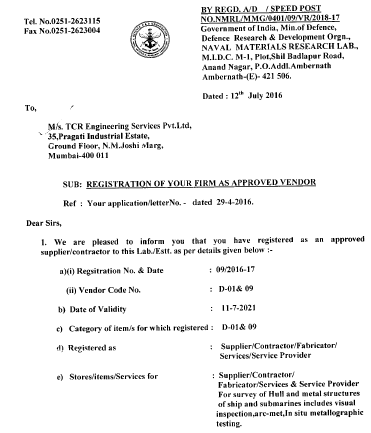
Materials testing lab and NDT Services of TCR Engineering will serve DRDO, India
Facility at TCR for all PhD students in the metallurgical faculty at Maharaja Sayajirao University of Baroda
Yes. TCR Advanced designs and fabricates custom autoclaves, sour-service cells, electrochemical rigs and instrumented fixtures, commissioned with full metrological traceability under ISO/IEC 17025:2017. The marquee reference is the corrosion-autoclave methodology built for the Institute of Plasma Research and cross-checked against ITER at Cadarache, France.
Yes. TCR Advanced has been recognised as a PhD research institute by MS University of Baroda since 2012, enabling doctoral research on metallurgy, corrosion and asset integrity from the Vadodara bench, with Dr. P.B. Joshi, co-author of ASM International titles, as the senior academic anchor.
Six creep frames run at 50 kN to 1,100 °C with test durations to 100,000 hours, a structural advantage for long-duration research campaigns.
Three scanning electron microscopes at TCR Advanced Vadodara: Pemtron SS100, Jeol JCM 6000+ and Phenom XL G2 with a CeB6 source at 60,000x magnification. The fractography stack is supported by the ARMI and MBH certified reference material panel and ISO 17034 methodology.
Since 6 December 2013. The three-temperature protocol at 300, 500 and 800 °C was qualified for NPCIL and returned in service in 2025-26 with Avinash Tambewagh as Technical Head, twelve years of methodology continuity on a single high-stakes contract research programme.