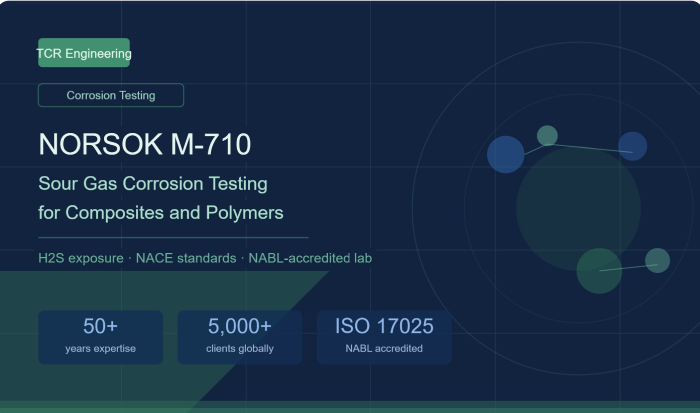
NORSOK M-710 Sour Gas Corrosion Testing for Composites and Polymers
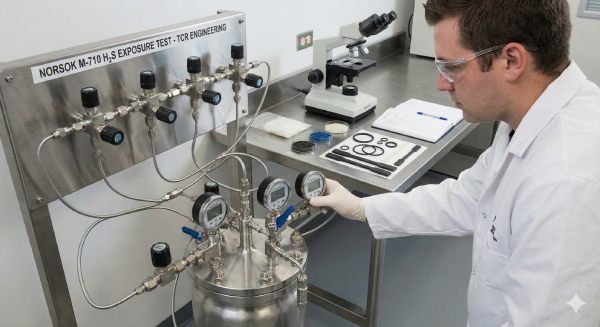
NORSOK M-710 corrosion testing for composites and polymers: how the standard works, what labs must provide, and where most programmes go wrong.

Group
Services · Materials Testing
Mica for electric-vehicle battery thermal insulation joined the bench in May 2026, alongside tile adhesive testing to IS 15477 and FRP/GRP pipe qualification for hydrostatic, axial-load and cyclic-pressure performance.
TCR Engineering tests polymers, rubbers, composites and FRP/GRP materials for mechanical, thermal and environmental performance at its NABL ISO/IEC 17025:2017 accredited laboratory (NABLT0726MH18640) in Navi Mumbai. The bench covers tensile, flexural, compression, impact and hardness testing alongside DSC, TGA, FTIR, filler identification, density, water absorption and FRP/GRP pipe qualification.
Testing of polymers, rubbers, and fibre-reinforced plastics for mechanical and environmental performance. Tensile, flexural, compression per ASTM D638, ASTM D790, ASTM D695. Izod impact on plastics per ASTM D256. Hardness (Shore A, D, IRHD) per ASTM D2240. Thermal properties: glass transition temperature, melting point, coefficient of thermal expansion, TGA, DSC. Environmental: accelerated weathering, UV resistance, heat ageing. FRP/GRP pipe qualification for hydrostatic performance, axial load, and cyclic pressure. ISO 527, ISO 178, ISO 179, ISO 180.
Mica testing for EV battery thermal insulation was added in May 2026. Tile adhesive testing per IS 15477 (comprehensive shear, pull-off, open time, and slip tests) supports the construction-materials buyer.
Rubber and polymer characterisation also covers compression set and compressive strength on rubber, water absorption, filler content and identification, density, Fourier-transform infrared spectroscopy (FTIR).
At our advanced materials testing lab in India, we offer comprehensive testing services for composites, plastics, and rubber to ensure the quality, durability, and performance of your materials.
Our services include:
These tests ensure compliance with industry standards and provide insights into material performance for demanding applications.
Standards: ASTM D638, D790, and D695 (tensile, flexural, compression), ASTM D256 (Izod impact), ASTM D785 and D2240 (hardness). ISO 527, ISO 178, ISO 179, ISO 180. IS 15477 (tile adhesive).
2 published insights on this site bear directly on Composites and Polymers. They are shown below alongside the most recent Materials Testing work, and the full index carries all 135.
NORSOK M-710 corrosion testing for composites and polymers: how the standard works, what labs must provide, and where most programmes go wrong.
Polymer testing per NORSOK M-710 reveals H₂S resistance and chemical compatibility. TCR validates materials for critical oil & gas applications.
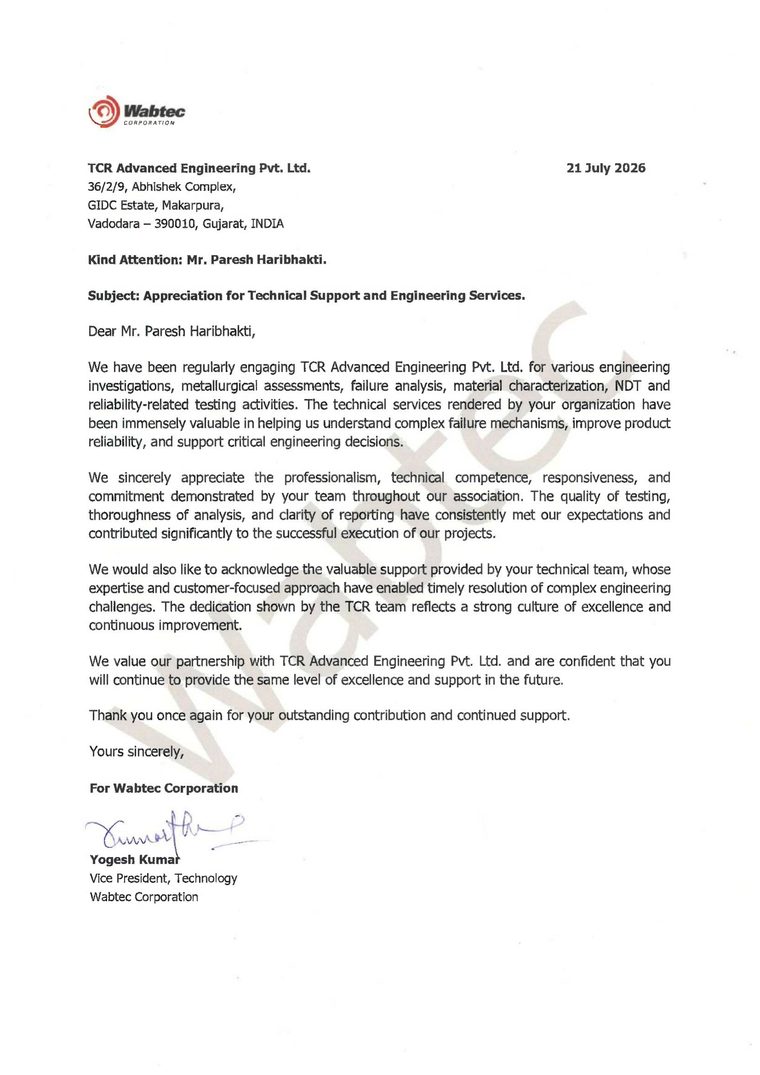
Wabtec Corporation has written to TCR Advanced Engineering to record its appreciation for engineering investigations, metallurgical assessments,…
Tensile, flexural and compression testing per ASTM D638, ASTM D790 and ASTM D695, Izod impact per ASTM D256, and hardness per ASTM D785 and ASTM D2240 including Shore A, Shore D and IRHD scales. Equivalent ISO methods 527, 178, 179 and 180 are also covered, with FRP/GRP pipe qualification for hydrostatic, axial and cyclic pressure performance.
Differential scanning calorimetry for thermal properties and glass transition, thermogravimetric analysis for weight change on heating, and FTIR for chemical bond identification. The laboratory also measures melting point, coefficient of thermal expansion, filler content and identification, density and water absorption, supporting quality control and material characterisation for demanding applications.
Accelerated weathering, UV resistance and heat ageing address environmental performance. Rubber characterisation covers compression set, compressive strength, Shore and IRHD hardness, density and water absorption. Tile adhesive testing per IS 15477 covers shear, pull-off, open time and slip, and FRP/GRP pipes are qualified for hydrostatic performance, axial load and cyclic pressure.