Service Applications Across the TCR Continuum
A refinery buys integrity services against three recurring pressures.
In operation, the problem set is high temperature hydrogen attack in hydroprocessing reactors, sulfidation and naphthenic acid corrosion in the crude and vacuum train, polythionic acid stress corrosion cracking that forms in sensitised austenitic internals the moment a unit is opened for shutdown, creep in heater tubes, and corrosion under insulation across the tank farm and piperack. During shutdown and turnaround, the pressure is time: inspection windows are compressed, discovery work erupts mid-turnaround, scaffolding dominates cost, and qualified API 510, API 570, and API 653 inspectors are scarce exactly when every refinery in the region wants them. In procurement, the risk is material: mis-certified alloy at the pipe mill, positive material identification gaps in incoming spools, and long-lead forgings that arrive without credible test evidence. TCR Engineering and TCR Advanced service all five stages of the five-stage Trusted Relationship Model (see Why TCR) against exactly these pressures.
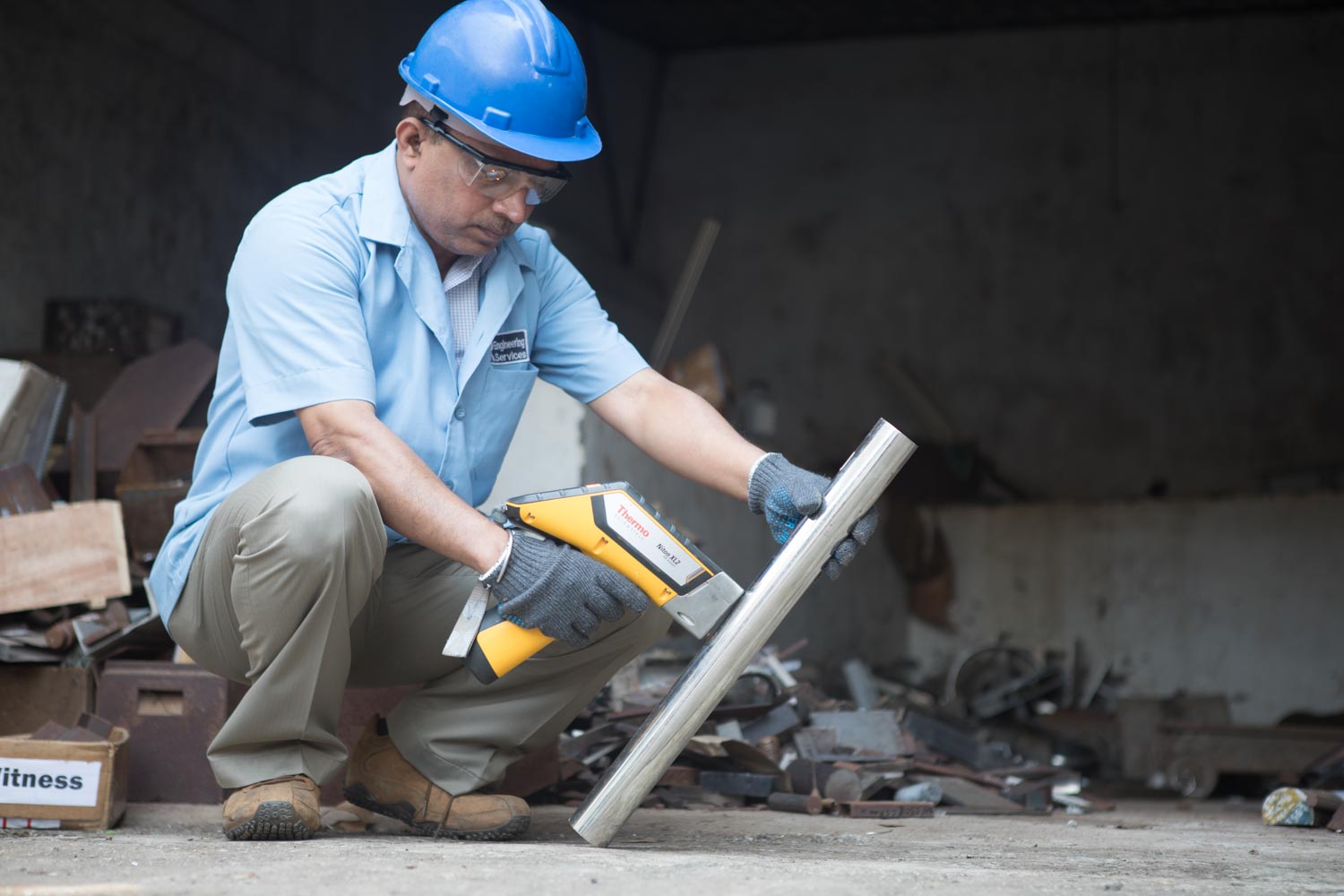
Stage One, Sourcing and Procurement: TCR runs factory audits and original equipment manufacturer qualification at pipe mills, forge shops, and valve and fitting vendors, with raw material inspection, sample picking, in-production checks, and loading supervision. Procurement samples are tested in the NABL NABLT0726MH18640 accredited laboratory: mechanical testing per ASTM A370 and ASTM E8/E8M, impact per ASTM E23, sour service qualification through sulphide stress cracking per NACE TM0177-2016 and hydrogen induced cracking per NACE TM0284, intergranular corrosion per ASTM A262, and positive material identification per API RP 578, so that hydrogen service steels and sour service materials per NACE MR0103 enter the plant with defensible evidence.
Stage Two, Construction and Commissioning: During unit construction, revamps, and capacity expansion, TCR provides baseline non-destructive testing: phased array ultrasonic testing and time of flight diffraction on thick-wall welds, radiography with robotic crawlers on piping, welder certification and procedure qualification per ASME Boiler and Pressure Vessel Code Section IX, weldability and consumable evaluation, post-weld heat treatment, and positive material identification on every alloy joint. The output is the baseline data set, thickness grids, weld maps, and material records, against which every later inspection of the unit is measured.
Stage Three, In-Service: On-stream, TCR deploys advanced non-destructive testing for high temperature hydrogen attack detection per API RP 941, hydrogen induced cracking mapping, carburisation screening, high temperature corrosion mapping on live equipment, and mid-wall fissure detection, supported by thermography of fired heaters, remote visual inspection, and robotic tools. TCR Advanced builds the risk-based inspection plan per API RP 580 and API RP 581 through the Knowledge-Based Audit method and sets integrity operating windows per API RP 584, so that inspection effort concentrates where damage-mechanism susceptibility per API RP 571 actually sits.
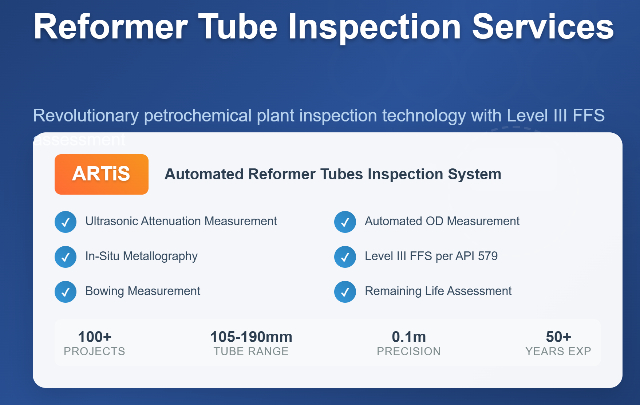
Stage Four, Shutdown and Turnaround: In the turnaround window, TCR delivers pipeline and weld inspection, heat exchanger tube inspection, in-situ metallographic replication on heater tubes, reactors, and hot piping by the twelve dedicated field teams, storage tank inspection per API 653 including in-service robotic crawling, coke drum and boiler condition assessment, robotic reformer tube inspection with ARTiS on hydrogen and steam methane reformer units, and turnaround inspection manpower with API 510, API 570, and API 653 qualified inspectors, sized to the shutdown and released when it closes.
Stage Five, Continuum: The forward-looking stage converts findings into operating decisions: failure analysis per API RP 585, remaining life assessment of heater tubes per API 530, fitness for service per API 579-1/ASME FFS-1 on hydroprocessing reactors, columns, and vessels, fire damage assessment per API 579-1 Part 11, integrity operating window refinement per API RP 584, engineering design and analysis, and the contract research, including renewable feed and co-processing corrosion studies, that feeds the next procurement cycle.