Free Webinar on Metallographic In-Situ Replica
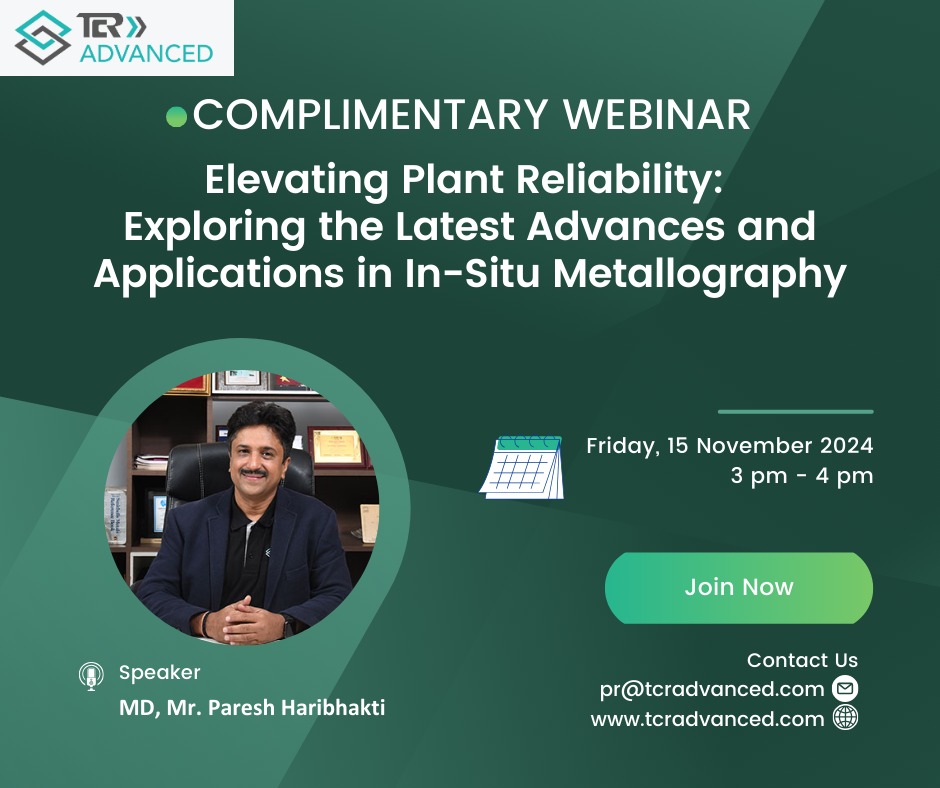
Join our free webinar on the latest advancements in in-situ metallography and how they can help enhance your plant’s operational efficiency.

Group
Services · Asset Integrity and Engineering Consulting
The reference base runs to more than 100,000 in-situ microstructure replicas logged over four decades of field service, read against ASTM E1351. Custom-built polishing devices let the field teams replicate warm components in positions that defeat standard kit.
TCR Engineering Services Pvt. Ltd., NABL ISO/IEC 17025:2017 accredited in Navi Mumbai, performs in-situ metallography and microstructural replication per ASTM E1351 on live plant components. Field teams polish, etch and replicate the surface, interpret the replica the same day, and read it against a reference database of more than 100,000 microstructures.
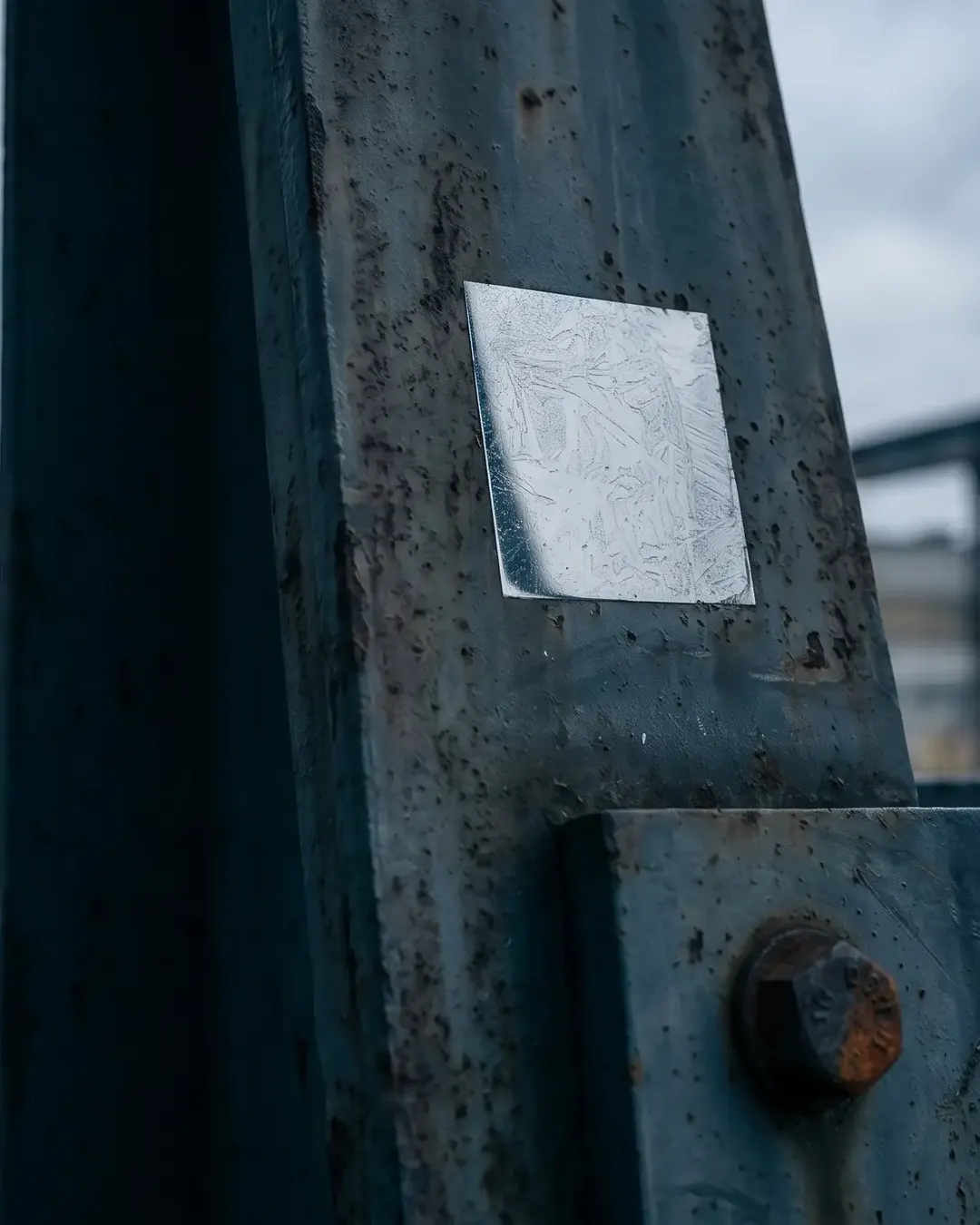
In-situ metallography is the flagship value-add of the group and the technique on which much of the asset-integrity practice rests. It reads the microstructure of a high-temperature component while that component stays in place, with no cutting, no sample removal, and no loss of pressure boundary. The metallurgist prepares a small area on the live surface, grinds and polishes it to a mirror finish, etches it, lifts a replica of the microstructure, and reads that replica under the microscope in the laboratory.
TCR Engineering under the NDT service performs In-Situ Metallography to determine in-service degradation of critical components of process and plants operating under high temperature, high-pressure and corrosive atmospheres. The technique enables real-time component condition monitoring and health assessments.
TCR’s Metallurgists have strong experience in the interpretation of microstructures and have more than 100,000 in-situ microstructure replicas, logged and captured in its proprietary database. These databases contain extensive information from various plants, captured over the course of four decades of service. The database also includes rare collections of varying microstructure damage levels from various industries such as power, oil and gas, petrochemical, fertilisers among others.
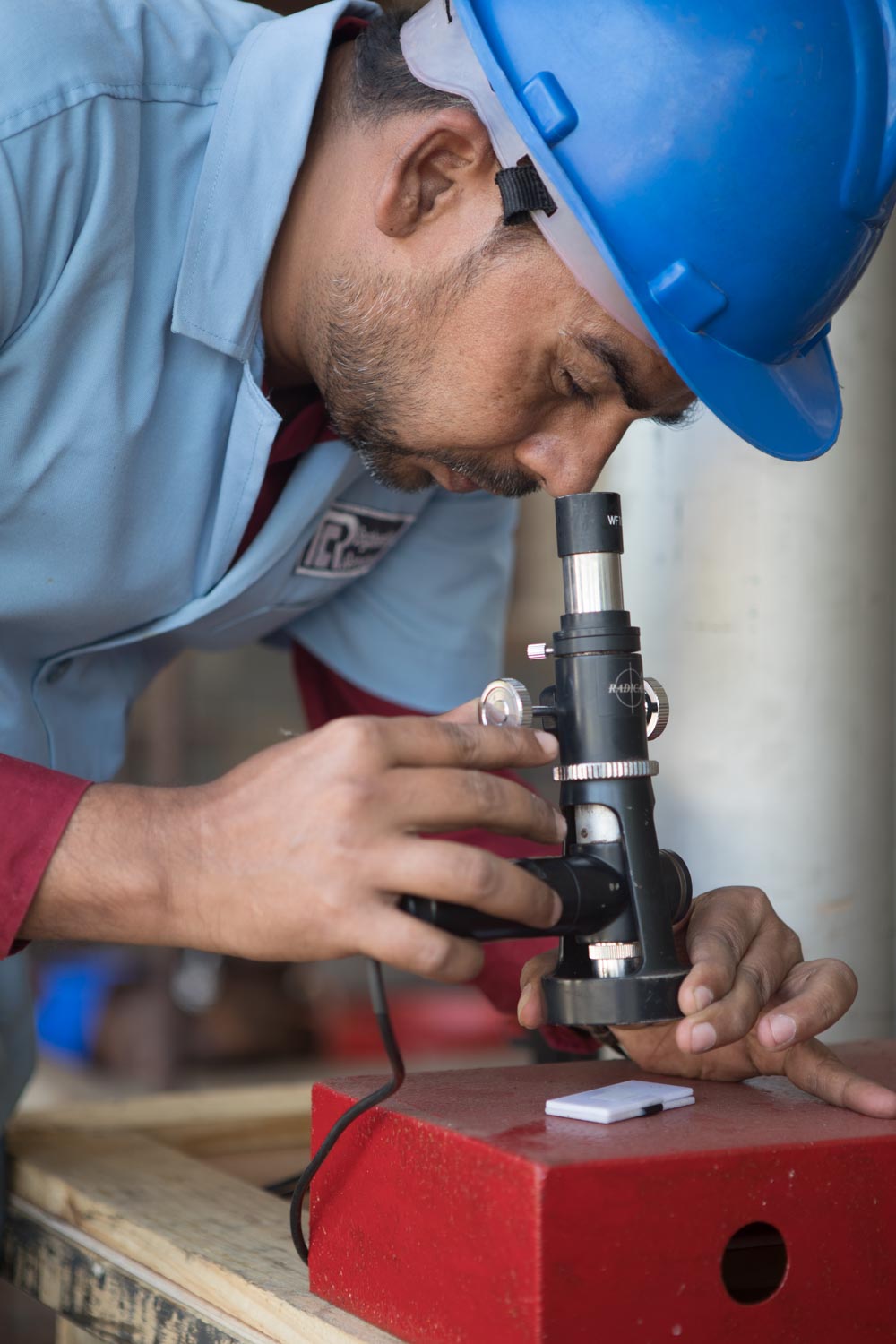
The In-Situ Metallography team at TCR is highly skilled in the art of replica preparation. TCR has custom-developed special purpose in-situ polishing devices that assist in metallographic polishing under difficult locations and allows the field services team to carry out high-quality replication even on warm components.
TCR provides microstructure survey for critical components viz., Boilers, Pipelines, Reactors and Vessels for monitoring and health assessments. TCR has developed a databank of critical components of process plant equipment by periodical monitoring for preventive maintenance and planning for inventory control. With this, TCR can provide suggestions on repair and welding of used components of process plants.
In-situ Metallography and replication is used for microstructural analysis while examining large components that cannot be easily moved or destructive sample preparation is difficult or not permissible. The testing allows quick on-site evaluation of a component’s metallurgical and heat treatment condition and assists investigators while carrying out a remaining life assessment study or a failure analysis project.
Metallography Replica Interpretation
At material testing laboratories in Mumbai and Baroda, India, TCR has an advanced Inverted Metallurgical Microscope, GX51, from Olympus Corporation, Japan. This Inverted Metallurgical Microscope allows expert metallurgists at TCR to perform Volume Fraction Measurement by point count method as per E-562 used for Duplex Steel and Carbide Morphology Distribution as per STAHL-EISEN-PRUFBLATT 1520 (SEP-1520) German chart for checking microstructure.
TCR Engineering Services has undertaken In-situ Metallography projects at major plants of reputed clients including, Alstom Projects India Limited, Vadodara (Worked on more than 20 RLA projects), BARC (Mumbai), Heavy Water Board (Mumbai), BARC, Reliance Industries Limited (Jamnagar and Hazira), SPIC-SMO, Gujarat Electricity Board, Ahmedabad Electricity Board, GSFC Limited, GNFC Limited, IOCL (Vadodara), L & T, Hindustan Lever Limited (9 Boiler RLA Work), Narmada Chematur Petrochemicals Limited, Bharuch and many more.
At TCR, the following sets of In-Situ Metallography kits and equipment are available:
KEY INFORMATION FOR REPLICATION INTERPRETATION
The work runs as one chain.
The replica is taken at the plant by a field team, interpreted the same day at the field site for the go or no-go call, then carried to the laboratory for full microstructural reading under optical and scanning electron microscopy, and finally logged against the reference database so that today’s microstructure can be compared with the same component years earlier and with the population of similar components across the archive. Same-day interpretation at the site is the commercial promise: when a creep-cavitation study comes off a reformer tube or a superheater during a turnaround, the operator gets the call inside the shutdown window, not weeks later.
The replica records the state of the microstructure and therefore the damage the component has taken. Creep cavitation is classified through its stages, from isolated cavities to oriented cavities, micro-cracks, and macro-cracks, so that the remaining safe life can be judged.
The same reading identifies the operative degradation: spheroidisation and carbide coarsening in ferritic steels, graphitisation, sigma-phase embrittlement in stainless steels, decarburisation, and the microstructural signatures of overheating. Hardness is taken in-situ alongside the replica, and where the case requires it the area is examined under SEM with EDS for chemistry, with colour metallography and chemical-composition mapping used to resolve weld dilution and difficult phase boundaries.
The technique is the backbone of remaining-life assessment on elevated-temperature plant.
On boilers it reads superheaters, reheaters, water walls, headers, and drums; on the steam circuit it reads main steam lines and hot reheat lines; on hydrogen and reforming plant it reads reformer tubes, pigtails, and outlet headers; and across refining and petrochemicals it reads pressure vessels, transfer lines, and fired-heater coils. It is one of the standard tools in the boiler RLA stack alongside ultrasonic testing, internal oxide-scale measurement, dimensional survey, and accelerated creep-rupture testing, and it feeds fitness-for-service, root-cause failure analysis, and knowledge-based audit work. Across the group the capability is delivered in India by the TCR Engineering and TCR Advanced benches and in the Kingdom by TCR Arabia, where Syed Ahsan Ali leads replication on boilers, main steam lines, and pressure vessels for clients including SABIC affiliates, MAADEN, and Saudi Railway.
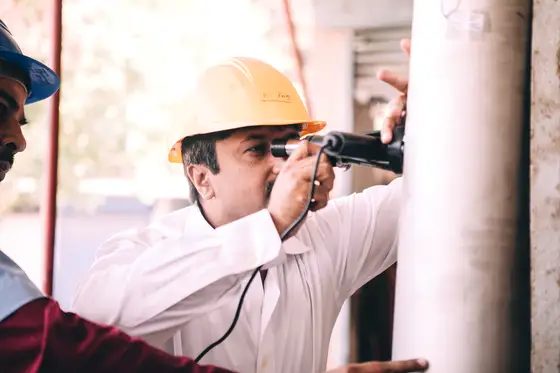
Field replication at scale is an operator-side capability, not a laboratory line item. A single replica team is a calling card; the group fields twelve dedicated in-situ replica field teams, which is an industrial capacity.
Behind the teams sits a reference base of more than 100,000 replicated microstructures built up over the archive, three scanning electron microscopes at TCR Advanced Vadodara, and a named metallurgist bench led by Paresh Haribhakti and supported by Mukesh Kumar in Mumbai and Syed Ahsan Ali in Dammam. TCR has also developed the Microstructure Characterizer image-analysis software and custom colour-metallography and electrolytic-polishing techniques that sharpen interpretation of difficult microstructures. The combination of field reach, a deep comparison archive, in-house electron microscopy, and a pioneer-led bench is what turns a replica from a photograph into a remaining-life decision.
ASTM E1351 (field metallographic replication), ASTM E3 (preparation of metallographic specimens), ASTM E407 (microetching), ASTM E112 (grain size), ASTM E45 (inclusion rating), and ASTM E1245 (image analysis), with creep-cavitation classification read against the recognised cavitation-stage scale and the boiler regime worked to IBR and ASME guidance.
Every in-situ metallographic replica that has gone through the TCR Advanced and TCR Engineering benches over the last three decades has been physically retained and image-archived. The reference base now stands at 100,000+ replicated microstructures (250,000+ metallographic records when the broader chemical and mechanical lab archive is included). The base supports two specific commercial outcomes.
The database sits behind the Knowledge-Based Audit practice, the Boiler RLA service, and the ARTiS reformer tube assessment, and feeds the AiOM damage-mechanism library, which now covers approximately 70 mechanisms aligned to API RP 571, WRC 489, WRC 488, WRC 490, and the ASM Handbook.
Field-replica capability is operator-side. A single team is a calling card; twelve teams is an industrial capability. TCR Group fields twelve dedicated in-situ metallographic replica teams, with the calibrated portable kit (replica tape per ASTM E1351, etching reagents, micro-hardness, deposit lifting, and image capture), trained-up replica technicians and reading metallurgists, and the cloud-archival workflow back to the master database.
Reference engagement: Reliance Industries Jamnagar fielded 1,200 in-situ replicas in 15 days during a turnaround window.
6 of the 86 published insights tagged to Asset Integrity bear directly on In-situ Metallography. The 6 most relevant are below.
Join our free webinar on the latest advancements in in-situ metallography and how they can help enhance your plant’s operational efficiency.
Analysis of Replica's originated from the Metallography Replication (MR) / in-situ metallography activity to the labs of TCR
Mr. Paresh Haribhakti, MD, TCR delivered a lecture on In-situ Metallography Replica
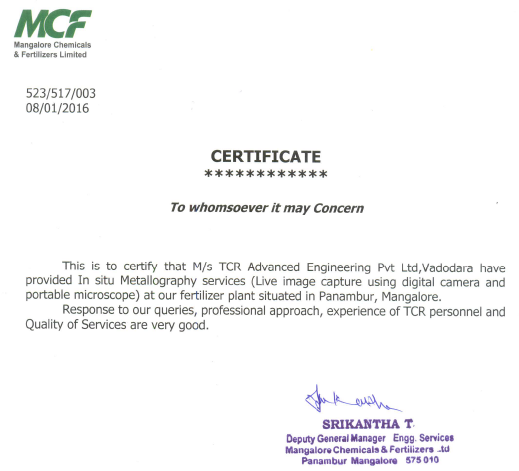
TCR Advanced Engineering received an appreciation letter for providing in-situ metallography by live image capture which results in...
Paper on In-Situ Metallography for the Plant Health Assessment Study and Failure Investigation
Complete investigation on the cause of damage of a crane’s runner wire rope
In-situ metallography reads the microstructure of an in-service component while it stays in place, with no cutting, no sample removal and no loss of pressure boundary. A small area is ground, polished and etched on the live surface, a replica is lifted, and the microstructure is read under the microscope for condition and health assessment.
The replica is interpreted the same day at the field site for the go or no-go call, then carried to the laboratory for full reading under optical and scanning electron microscopy. During a turnaround, the operator gets the call inside the shutdown window, not weeks later, before the replica joins the reference database.
Creep cavitation classified from isolated cavities through oriented cavities, micro-cracks and macro-cracks, plus spheroidisation and carbide coarsening, graphitisation, sigma-phase embrittlement, decarburisation and overheating signatures. Hardness is taken in-situ alongside the replica, and SEM with EDS resolves chemistry where the case requires it.
Boiler superheaters, reheaters, water walls, headers and drums; main steam and hot reheat lines; reformer tubes, pigtails and outlet headers; and pressure vessels, transfer lines and fired-heater coils across refining and petrochemicals. It is a standard tool in the boiler RLA stack and feeds fitness-for-service and failure analysis.
Field replication is worked to ASTM E1351, with ASTM E3 specimen preparation, E407 microetching, E112 grain size, E45 inclusion rating and E1245 image analysis. Creep cavitation is read against the recognised cavitation-stage scale, and the boiler regime is worked to IBR and ASME guidance.