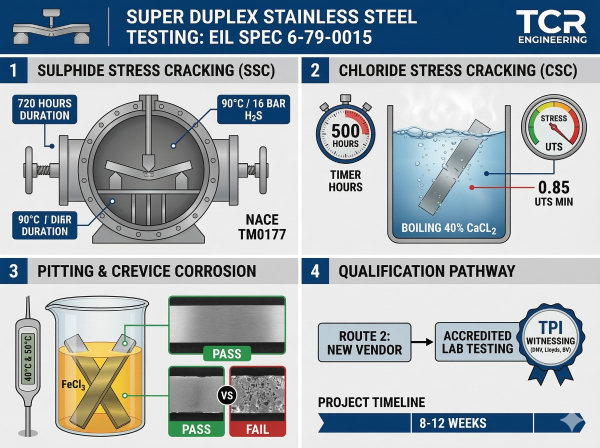
Super Duplex Stainless Steel Testing as per EIL Spec 6-79-0015
EIL 6-79-0015 SDSS pre-qualification explained: corrosion tests, TPI requirements, timelines, and what procurement teams must plan for before sample…

Group
Industries
Tubing, risers and trees are qualified against H2S here: SSC and HIC testing to NACE TM0177 Methods A through D, with active laboratory approvals at Saudi Aramco, ADNOC and Petroleum Development Oman.
Request a QuoteTCR is on ONGC’s approved-laboratory register since 1998, First Article Qualification for the world’s wellhead OEMs, and the sour-service bench that qualifies tubing, risers and trees against NACE MR0175/ISO 15156 (materials for use in H2S-containing environments in oil and gas production); NACE MR0103 (for refining-adjacent service, cross-vertical); NACE TM0177-2016 Methods A through D (laboratory testing of metals for resistance to SSC and SCC in H2S environments).
TCR holds ONGC’s QAD approval Serial No. 01, the very first name on the list, held continuously since 1998, and runs First Article Qualification for Cameron, NOV, Halliburton, Schlumberger, Baker Hughes and Weatherford, with active approvals at Saudi Aramco, Dangote and PDO.
POTENTIAL FAILURES WE SERVICE: Leaks, blowdowns and equipment failures across wellhead hardware, tubing, risers, manifolds and offshore platforms. TCR analyses sour-service cracking (SSC, HIC, SOHIC), CO2 and H2S corrosion, sand-cut and slug erosion, riser and vibration fatigue, and weld-toe defects, plus First Article Qualification on new wellhead equipment at the manufacturing source.
Upstream operators carry inspection obligations at both ends of the asset life. Ageing fields and sour service drive integrity spend during operation, while decommissioning sits on the balance sheet as a formal asset retirement obligation under Ind AS and IFRS, with the worldwide oil and gas decommissioning liability independently estimated at USD 311 to 362 billion.
Between those two poles sits a continuous demand for materials qualification, corrosion testing, and fitness for service judgement. TCR's sour-gas laboratory runs SSC, HIC, and SOHIC programmes to NACE and ISO 15156 against Petroleum Development Oman, Saudi Aramco, and ONGC/EIL specifications, and the group's FFS and failure analysis bench converts inspection findings into defensible run, repair, or retire decisions.
The upstream oil and gas vertical splits across three buyer pools:
The Indian onshore and offshore operator pool (ONGC, Oil India, Cairn Oil and Gas, Reliance KG-D6, Vedanta) anchors the long-tenure relationships, with TCR's ONGC empanelment representing the single longest active vendor relationship in the company's history.
The GCC and MENA upstream pool (Saudi Aramco, ADNOC, PDO, OQGN, KOC, Qatar Energy, KNPC, Iraqi Ministry of Oil, PetroChina International Iraq) carries the volume of cross-border and field-services-adjacent work via TCR Arabia and TCR Advanced.
The international oilfield-services and equipment-OEM pool (Halliburton, Schlumberger, Cameron International, NOV Inc., Baker Hughes, Weatherford, GE International) sources verification testing, First Article Qualification, and audit-grade material certification.
The static-equipment specialist line is held: TCR is the laboratory and integrity bench for storage tanks, pressure vessels, separator and slug catcher, manifold piping, and wellhead-adjacent fixed equipment, not a rotating-equipment field service contractor.
The CO2 EOR (enhanced oil recovery) trend in the Indian onshore basins (Bombay High, Cambay, Krishna-Godavari, Cauvery) brings supercritical CO2 piping and reservoir-tie-in qualification work. CCUS at offshore platforms brings cross-vertical scope with Pipelines and Marine. Hydrogen blending in natural-gas trunklines brings API 941 HTHA discipline and ASTM F519 / API 20E hydrogen embrittlement bench into upstream operator-side scope. The decommissioning agenda (legacy offshore platforms, idle wells, abandoned pipelines) brings structural assessment and material recovery scope.
TCR is the laboratory and integrity bench for the sour and sweet service surface area, the wellhead-equipment First Article Qualification stream, and the Aramco-grade ECA and RT capability that the upstream vertical demands.
| Cluster | Equipment |
|---|---|
| Onshore production | Wellhead and Christmas tree (statutory inspection scope), separator (HP, MP, LP), test separator, slug catcher, manifold, gas dehydration (TEG, MEG), produced-water treatment, gas compressor station |
| Offshore production | Topsides separator and process train, riser and J-tube, jacket structure (cross-vertical with Marine), subsea manifold tie-in (cross-vertical with Pipelines), boat landing |
| Storage and Stabilisation | Crude and condensate stabilisation column, storage tanks (API 650, API 620 where low-pressure), spheroids |
| Gas Processing | Acid-gas removal (amine, MEA, MDEA), dehydration (TEG glycol, mol-sieve), NGL extraction (turbo-expander section), LPG fractionator |
| Sour Service | Sour-crude and sour-gas piping, separator, slug catcher; H2S scavenger system |
| Pipeline Tie-In | Wellhead to manifold to gathering, pig launcher and receiver; cross-vertical with Section 11d Pipelines |
| Wellhead Equipment Verification | Cameron International, NOV Inc., Halliburton, Schlumberger, Baker Hughes equipment First Article Qualification testing |
| Category | Mechanisms |
|---|---|
| Sour service | Sulphide stress cracking (SSC), hydrogen-induced cracking (HIC), stepwise cracking (SWC), stress-oriented HIC (SOHIC); per NACE MR0175 / ISO 15156 |
| CO2 corrosion | Sweet (CO2) corrosion, top-of-line corrosion, mesa attack, pitting under deposit |
| Combined sour and sweet | CO2/H2S synergistic corrosion (the AiOM-CCP undersea pipeline case framework) |
| Erosion-corrosion | Sand-cut erosion at choke and elbow, slug erosion at riser bend |
| Mechanical and fatigue | Vibration-induced fatigue, riser fatigue, dent and gouge from third-party |
| Material and weld | HAZ embrittlement, weld toe cracking, lack of penetration, lack of fusion |
| Equipment First Article | Manufacturing defect identification at the source-inspection stage |
Sour Service: NACE MR0175 / ISO 15156 (materials for use in H2S-containing environments in oil and gas production); NACE MR0103 (for refining-adjacent service, cross-vertical); NACE TM0177-2016 Methods A through D (laboratory testing of metals for resistance to SSC and SCC in H2S environments); NACE TM0284 (HIC); NACE TM0316 (four-point bend); NACE TM0198 (slow strain rate test); EFC Publication 16 (CO2 resistance materials).
RBI / FFS / ECA: API 580 / 581 4th ed. (January 2025); API 579-1/ASME FFS-1 4th ed. (2021); BS 7910; API 1104 22nd ed. (2021) Annex A.
Inspection Codes: API 510, 570, 653; API RP 572, 574, 575; API RP 941 HTHA where hydrogen service is in scope.
Asset Integrity Management: Asset Integrity Management for Offshore and Onshore Structures, M. El-Reedy (1st ed., 2022).
Welding and Material: ASME Section IX 2023; AWS D1.1 2025; API 1104 22nd ed.; API 5L 46th ed.; ASTM A106 (carbon steel piping for high-temperature service); ASTM A335 P22, P11; ASTM A516 Grades 60, 65, 70 (carbon steel pressure-vessel plates); ASTM A537 Class 1 / 2.
Construction: ASME Section VIII Div. 1, Div. 2; ASME B31.3 (process piping); ASME B31.4 / B31.8 (pipeline transportation systems); API 650, API 620.
Upstream oil and gas buys integrity against sour service.
Hydrogen sulphide partial pressure governs material selection for wellheads, christmas trees, downhole tubulars, flowlines, and separators per NACE MR0175/ISO 15156, and the laboratory evidence behind that selection, sulphide stress cracking, hydrogen induced cracking, and stress-oriented hydrogen induced cracking, is where TCR runs one of the largest sour service testing capacities in India. In operation the problem set widens to carbon dioxide corrosion in flowlines, microbiologically influenced corrosion in water systems, fatigue of structural connections offshore, and erosion in sand-producing wells. Shutdown windows on production facilities are short and weather-bound; procurement risk sits in forgings, seals, and elastomers for high pressure high temperature service. TCR Engineering and TCR Advanced service all five stages of the five-stage Trusted Relationship Model (see Why TCR) for onshore and offshore operators and their equipment manufacturers.
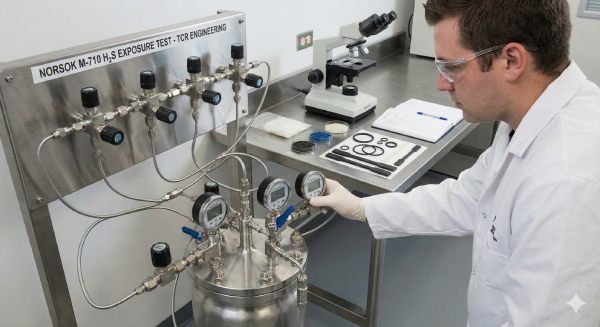
Stage One, Sourcing and Procurement: Materials for sour service are qualified through sulphide stress cracking per NACE TM0177-2016 Methods A through D including four-point bend, hydrogen induced cracking per NACE TM0284, stepwise cracking and stress-oriented hydrogen induced cracking, hydrogen embrittlement testing, and NORSOK M-710 qualification of polymers, elastomers, and composites for sour exposure. Forging and valve vendor audits, sample picking, in-production checks, and loading supervision protect the supply chain for wellhead and pressure-control equipment.
Stage Two, Construction and Commissioning: For gathering stations, processing trains, and terminal construction, TCR delivers baseline non-destructive testing on piping and vessels, phased array ultrasonic testing and time of flight diffraction, radiography, welder certification and procedure qualification per ASME Boiler and Pressure Vessel Code Section IX and API 1104, post-weld heat treatment with hardness control for sour service, and positive material identification, establishing the baseline record for each facility.
Stage Three, In-Service: On producing facilities, TCR runs corrosion mapping on separators, knockout drums, and flowlines, thickness monitoring programmes, remote visual inspection of confined and buried equipment, thermography, and risk-based inspection planning per API RP 580 and API RP 581, with integrity operating windows per API RP 584 tied to produced fluid chemistry so inspection intervals track actual corrosivity rather than design assumptions.
Stage Four, Shutdown and Turnaround: In the shutdown window, TCR inspects pressure vessels internally per API 510, exchanger and cooler tube bundles, storage tanks per API 653 including in-service robotic options, flare and relief system components, and structural steel, with in-situ metallographic replication on high temperature components and magnetic particle and penetrant testing on nozzles and attachment welds, supported by turnaround inspection manpower.
Stage Five, Continuum: Findings feed fitness for service per API 579-1/ASME FFS-1 on corroded vessels and piping, engineering critical assessment of flowline and riser girth welds, failure analysis of downhole, wellhead, and surface equipment including seal and elastomer failures, remaining life assessment of ageing facilities, and the materials-selection and contract research studies that qualify equipment for the next field development.
India Public Sector: Oil and Natural Gas Corporation (ONGC; QAD Sr. No. 01 since 1998), Oil India Limited, GAIL India Limited (cross-vertical with Pipelines).
India Private Sector Reliance Industries (KG-D6), Cairn Oil and Gas (Barmer, Ravva), Vedanta Limited, Adani-Total Energies (Dhamra LNG cross-vertical), Hindustan Oil Exploration Company.
GCC Upstream: Saudi Aramco (Vendor 10040677, ANDT Contract 6601000141), ADNOC, Petroleum Development Oman (PDO; approval refresh May 2022), Oman Gas Network (OQGN), Kuwait Oil Company (KOC), Qatar Energy, KNPC, PetroChina International Iraq FZE; Iraqi Ministry of Oil (approval since May 2019); Baiji Refinery (idle-plant restart project).
International: Shell (multiple geographies, sour-service approved through Shell-approved elastomeric and corrosion testing), BP, ExxonMobil (vendor-side via OEM source inspection), TotalEnergies, Pemex (Mexico).
Equipment OEMs and Oilfield Services: Cameron International (First Article Qualification testing since 2012, ongoing), NOV Inc. (March 2023), Halliburton, Schlumberger, Baker Hughes, Weatherford, GE International (3-year contract December 2012), SABIC Global Contract 4600006798 (vendor 505239).
| Project | Service Anchor | Year |
|---|---|---|
| ONGC QAD Sr. No. 01 (the longest-tenure approval; original approval letter MRBC/QAD/LAB/97-98/779 dated 25 February 1998) | Materials testing, NDT, source inspection across ONGC asset base for ferrous and non-ferrous metals, weld, glass, refractories, ceramics, and radiography | Since 1998 |
| Jindal SAW Limited Mundra Kutch for OQ Gas / OQGN Oman line pipe | Sour-service qualification (HIC per NACE TM0284 plus SSCC four-point bend per NACE TM0177 / ASTM G39 / OQGN docs); PO 4703000416 dated 01.07.2025 | July 2025 onward |
| Indorama Eleme Petrochemicals Limited, Port Harcourt, Rivers, Nigeria | Olefins furnace tubes condition assessment and NDT (in-situ metallography on SS304H with Aqua-regia etchant for 100 replicas, UCI hardness, permeability measurement, SEM analysis) | April 2025 onward |
| Saudi Aramco Jafurah Gas Compression Plants | ECA, PWIS Package-1 | 2024 to 2025 |
| Shell sour-service material qualification | NACE TM0177 / TM0284 / MR0175 testing campaigns | Continuous |
| Saudi Aramco Master Gas System (cross-package) | ECA per API 1104; L&T, Kalpataru Projects International, GAS Arabian Services delivery | Continuous |
| Cameron International | First Article Qualification testing | 2012 onward |
| NOV Inc. | Approval and source-inspection testing | March 2023 onward |
| Halliburton, Schlumberger, Baker Hughes, Weatherford | Vendor source-inspection and verification testing | Continuous |
| GE International | 3-year contract scope | December 2012 onward |
| SABIC | Global Contract 4600006798 | 2012 to 2017 |
| Casale SA (Switzerland) | SX3000 Vendor Code 1000007973 (urea and melamine licensor; cross-vertical with Fertilisers) | June 2025 onward |
| Petrokemya, KSA | RLA of fire-steam-tube boiler (cross-vertical with Power) | 2023 |
| PIC Fertilizer Plant, Kuwait (NBTC delivery) | RLA of 120 critical equipment in ammonia and urea plant (cross-vertical with Fertilisers) | 2024 |
For Petroleum Development Oman and OQ Gas Networks, TCR qualifies sour-service line pipe to PDO SP-2347 and OQGN G14-PD-PL, with hardness, HIC, and SSC acceptance read against criteria stricter than NACE. CTOD with hydrogen-sulphide pre-charging, developed for Larsen and Toubro, charges specimens for 96 hours in NACE TM0177 Solution A before loading within a 20-minute window.
Storage-sphere, terminal, and transfer-line investigations cover corrosion under insulation, pitting, and stress-corrosion cracking.
33 published insights on this site carry the Oil & Gas Upstream tag. The 6 most recent are below.
EIL 6-79-0015 SDSS pre-qualification explained: corrosion tests, TPI requirements, timelines, and what procurement teams must plan for before sample…
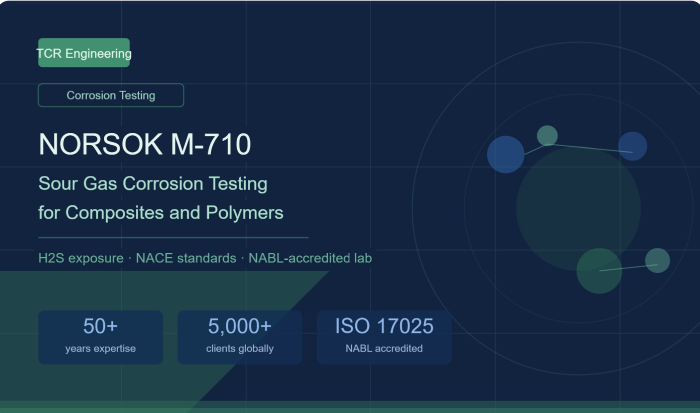
NORSOK M-710 corrosion testing for composites and polymers: how the standard works, what labs must provide, and where most programmes go wrong.
Polymer testing per NORSOK M-710 reveals H₂S resistance and chemical compatibility. TCR validates materials for critical oil & gas applications.
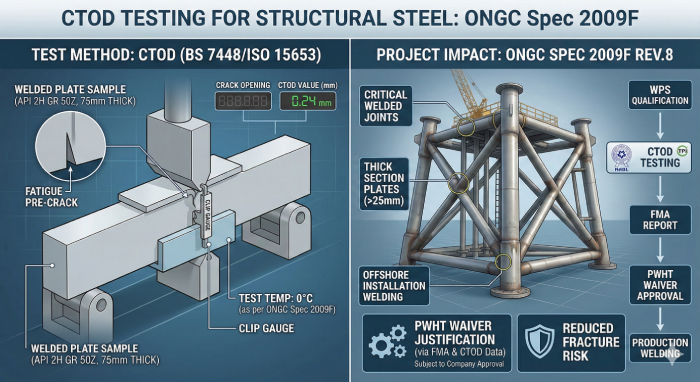
TCR Engineering explains CTOD testing requirements for structural steel under ONGC Spec 2009F Rev.8, including FMA, specimen prep, and accreditation.
TCR Engineering runs CTOD fracture toughness testing with H2S hydrogen pre-charging to ISO 15653, ISO 12135, and NACE TM0177 — for sour service weld…
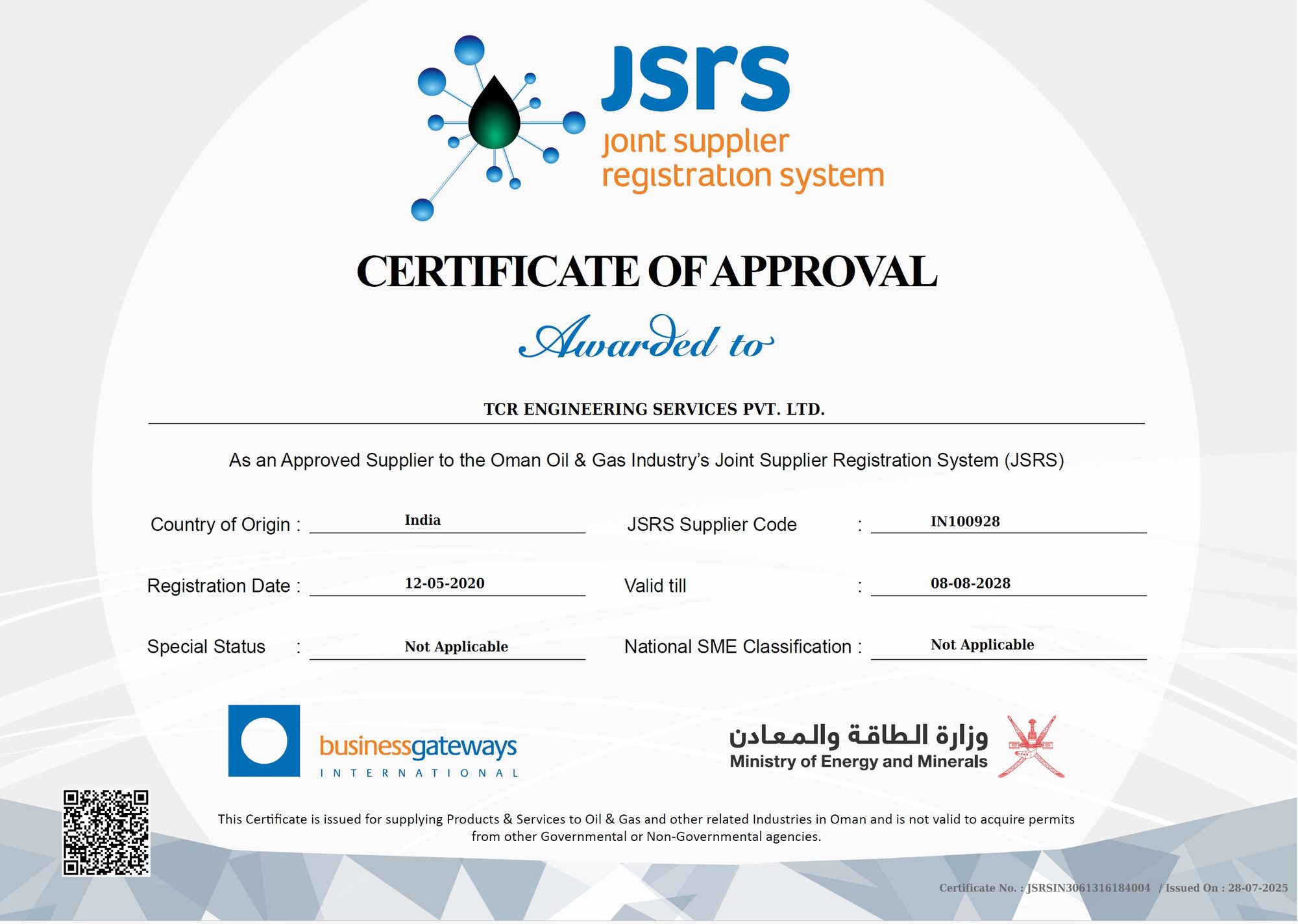
TCR Engineering offers JSRS-certified testing for OQGN and PDO specifications including HIC, SSCC, and CTOD testing for Oman oil and gas.
Since 25 February 1998, under original approval letter MRBC/QAD/LAB/97-98/779. TCR is Serial Number 01 on ONGC's approved-laboratory register, the longest-tenure approval on the panel, covering materials testing, NDT and source inspection across ferrous and non-ferrous metals, welds, glass, refractories, ceramics and radiography.
Sulphide stress cracking per NACE TM0177-2016 Methods A through D including four-point bend, HIC per NACE TM0284, stepwise cracking and SOHIC, slow strain rate per NACE TM0198, and qualification against NACE MR0175/ISO 15156, read against PDO SP-2347 and OQGN G14-PD-PL acceptance criteria stricter than NACE.
Yes. Cameron International has run First Article Qualification testing with TCR since 2012, NOV Inc. since March 2023, and Halliburton, Schlumberger, Baker Hughes and Weatherford route vendor source-inspection and verification testing through the same bench, with GE International on a contract from December 2012.
Yes. The CTOD programme with hydrogen-sulphide pre-charging, developed for Larsen and Toubro, charges specimens for 96 hours in NACE TM0177 Solution A and loads them within a 20-minute window, serving engineering critical assessment of sour-service girth welds and risers.
Yes. Saudi Aramco lists TCR as Vendor 10040677 with ANDT Contract 6601000141, PDO refreshed its approval in May 2022, and the Iraqi Ministry of Oil has approved TCR since May 2019, with work delivered for ADNOC, OQGN, KOC and Qatar Energy.