Reformer Tube Inspection Services Petrochemical: Why Your Plant's Future Depends on Getting This Right
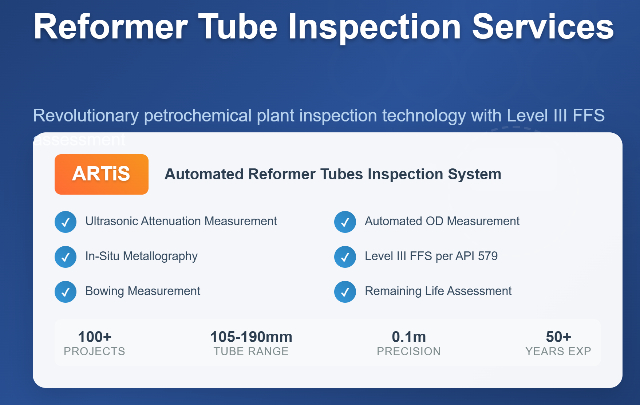
ARTiS revolutionises reformer tube inspection with Level III FFS assessment per API 579, predicting failures months ahead of traditional methods.

Group

Services · Asset Integrity and Engineering Consulting
More than 100 reformer-tube campaigns completed for clients in India and internationally. Automated crawlers cover tube outer diameters from 70 mm to 200 mm and feed a Level III fitness-for-service assessment per API 579-1/ASME FFS-1, with retirement called at 0.8 life fraction.
TCR Engineering Services Pvt. Ltd., a NABL ISO/IEC 17025:2017 accredited laboratory in Navi Mumbai, operates ARTiS, the group's automated reformer tube inspection system. The robotic crawler scans tube outer diameters of 70 mm to 200 mm and delivers Level 3 Fitness for Service assessments per API 579-1/ASME FFS-1 across India and the GCC.
At TCR we have developed ARTiS, the Automated Reformer Tube Inspection System, an advanced solution for the comprehensive assessment of reformer tubes. TCR has completed 80+ reformer-tube ARTiS inspections for clients in India and internationally, with 50,000+ tubes scanned cumulatively.
Our multidisciplinary approach incorporates Fitness for Service (FFS) analysis per API 579-1/ASME FFS-1 and features a unique ability to determine "when to retire tubes." Over the years, TCR has developed an extensive database of reformer tube failure mechanisms, allowing our research wing to identify early warnings of tube failures.
TCR's deep understanding of the operational and metallurgical interactions of reformer tubes, combined with our innovative ARTiS technology, enables us to deliver superior insights into the condition of your tubes. With automated crawlers that accommodate tube outer diameters from 70 mm to 200 mm in the current generation (105 mm to 190 mm on the earlier generation), ARTiS provides precise data for Level III FFS assessments, ensuring the accurate prediction of remaining tube life.
| Technique | Purpose and method |
|---|---|
| Multi-technique condition assessment | Combined techniques for detailed condition assessment of reformer tubes. |
| Level III FFS assessment | Per API 579-1/ASME FFS-1, for remaining life calculations. |
| Proprietary standard samples | Reference samples with known damage scenarios, offering superior accuracy. |
| Ultrasonic attenuation measurement | Fissure detection via automated crawler. |
| In-situ metallography | Microstructural analysis to assess microstructural degradation. |
| Visual inspection | Bulging, baldness, sagging, and bowing, assessed by an expert. |
| Automated outer diameter measurement | Electronic devices on ARTiS at 0.1 m intervals using infrared light sensors. |
| Automated bowing measurement | On-board electronic devices. |
| Hardness testing | At metallography locations. |
| Manual ultrasonic wall thickness measurement | At platform (bottom) level. |
| Magnetic permeability measurement | At platform level. |
TCR provides a detailed Level III FFS assessment in accordance with API 579-1/ASME FFS-1. Each assessment delivers a summary of accumulated creep damage, including calculation of effective tube metal temperature and projected creep damage up to the next shutdown. Retirement date prediction based on accumulated creep damage (0.8 life fraction). Remaining life assessment for each tube.
Reformer tubes operate above 800 degrees Celsius under internal pressure, where high-temperature creep shows up first as diameter growth of 1 to 6 percent and, in later stages, as internal fissures and bowing. ARTiS quantifies that damage tube by tube, and TCR classifies the creep stage against a microstructure database of roughly 1,000 catalogued spots covering virgin, in-service-aged, and failed tubes, read by in-house metallographers from surface replicas.
The condition result feeds a fitness-for-service judgment and a reuse, monitor, or replace decision on each tube. In-situ metallographic replication and reformer-tube condition assessment have been delivered to more than 50 plants in India and abroad, including GNFC Bharuch, GSFC Vadodara, CFCL Kota, IOCL Vadodara, BPCL Cochin and Mumbai, Reliance Jamnagar, Vadodara, and Hazira, Deepak Fertilizers, RCF Thal, and MAADEN in Saudi Arabia.
The crawler hardware, the transmit-receive ultrasonic method, and the attenuation-to-creep bands behind this service are described under Robotic Inspection.
ARTiS, the Automated Reformer Tube Inspection System, is the flagship robotic intellectual property of the TCR Group: developed and patented by TCR Advanced Engineering and deployed group-wide across India, the GCC, and international reformer fleets. The system carries reformer tube inspection through a helical scan with embedded Fitness for Service reporting per API 579-1/ASME FFS-1 and API 530.
With 80+ reformer inspection assignments completed for Indian and overseas clients and 50,000+ tubes scanned, TCR anchors the group's reformer tube integrity practice. The practice rests on a proprietary data bank of reformer tube failure mechanisms built over decades of failure investigations, which allows TCR to recognise the early warnings of tube failure, and on a unique combination of operational understanding and metallurgical interpretation of reformer service. The assessment answers the question every reformer owner actually asks: when to retire each tube.
| Capability | Detail |
|---|---|
| Tube inspection range | Outer diameter 70 mm to 200 mm with the current crawler generation; the earlier generation covered 105 mm to 190 mm (together spanning the fertiliser and refining reformer-tube sizes) |
| Length traversal | Full tube length, helical scan |
| Damage capture | Diametral creep growth, mid-wall cracks, internal carburisation, external oxidation, axial and circumferential creep cavitation |
| Output | FFS-grade report with creep grade A through E classification, remaining-life estimate, three-stream sentencing (Improve / Repair / Replace) |
| Cumulative tubes scanned | 50,000+ (group practice anchor) |
ARTiS is a TCR-built robotic crawler that automates the ultrasonic inspection of primary reformer tubes in place of manual scanning. It runs ultrasonics in transmit-receive (T-R) mode: energy passes from one sensor through the tube wall to a second sensor, and the energy lost to beam scatter is the measurement. In an as-cast tube that scatter comes from dendrite boundaries and primary carbides; after long high-temperature service, secondary-carbide precipitation and creep voids add to it.
TCR reads the resulting attenuation against calibrated bands: 35 to 55 dB for virgin structure, 55 to 62 dB for aged structure, and 62 to 72 dB at a life fraction of 80 to 95 percent, where secondary carbides have coarsened and inter-dendritic micro-cracks appear. The crawler is driven by four metal-gear motors rated 200 watts in total, with a rubber-padded shoe carrying the transmit-receive probes, infra-red sensors for diameter, and gyroscopic sensors for bowing. It scans 10 metres in 2 to 5 minutes at 100 mm resolution, fixes in 3 minutes, and climbs to 15,000 mm, accommodating tube outer diameters of 70 mm to 200 mm with the current crawler generation (105 mm to 190 mm on the earlier generation) and walls of 8 to 20 mm. The 25 mm, 1 MHz probe runs a 30 to 100 dB range at 0.1 dB resolution, with diameter resolved to 0.5 percent of outer diameter and bowing to 5 mm.
Against manual scanning, ARTiS removes the scaffolding requirement and inspects 100 tubes in about 2 days rather than 4 to 5, reports continuously at 100 mm resolution rather than in six-foot segments, measures outer diameter every 100 mm rather than at one or two points by hand, and returns a quantitative bowing figure of 5 to 200 mm rather than a visual estimate.
ARTiS is a multi-technique assessment. Every tube in the radiant box is examined through nine coordinated measurements, and TCR calibrates the crawler against proprietary standard samples with known damage scenarios, which gives the attenuation readings a validated reference that single-technique providers cannot match. The scope per tube covers:
The inspection feeds a Level 3 assessment per API 579-1/ASME FFS-1, delivered tube by tube. The report package carries:
The effective tube metal temperature is the anchor of the remaining-life mathematics. It is defined as the temperature that caused the present level of creep damage in terms of creep strain, accommodating occasional changes in tube skin temperature and thermal cycling; it is not the same as the pyrometer reading taken on the tube skin. Future life expectancy is acutely sensitive to it: field experience shows that an overshoot of 10 to 20 degrees Celsius above design can cut tube life substantially, which is why the ARTiS report carries a sensitivity analysis showing expected life at 10, 20, and 30 degrees Celsius above design for the worst tubes. That sensitivity table is what turns an inspection record into an operating decision: timely tube-replacement calls, budget allocation across tube and catalyst replacement, inventory build-up, and realistic downtime planning for the next turnaround.
| Client | Detail | Year |
|---|---|---|
| Dangote Fertilizers, Nigeria | ARTiS plus tail-tube inspection for reformer life extension | 2023 |
| Emirates Steel Industries, Abu Dhabi | ARTiS on Direct Reduction Plants DRP1 and DRP2 | 2025 |
| JIFCO, Jordan | RFET and videoscopy of WHRB tubes (companion to ARTiS workflow) | 2025 |
| Indian fertiliser engagements (multiple) | Continuous ARTiS rotation across CFCL, IFFCO, RCF, GNFC | Continuous |
| GNFC TDI-II Reformer | RLA on reformer tubes | Multiple |
Beyond the engagements above, ARTiS has been deployed across the Indian refining and fertiliser reformer fleet and at international sites. Reference sites for reformer tube inspection using ARTiS include:
| Client | Site | Sector |
|---|---|---|
| PEMEX | Salamanca Refinery, Mexico | Refining |
| Notore Chemical Industries Plc | Onne, Nigeria | Fertilisers |
| PT Musim Mas | Indonesia | Oleochemicals |
| Indian Oil Corporation Ltd. | Vadodara Refinery | Refining |
| Indian Oil Corporation Ltd. | Panipat Refinery | Refining |
| Indian Oil Corporation Ltd. | Digboi Refinery | Refining |
| Indian Oil Corporation Ltd. | Guwahati Refinery | Refining |
| Indian Oil Corporation Ltd. | Bongaigaon Refinery | Refining |
| Indian Oil Corporation Ltd. | Mathura Refinery | Refining |
| Indian Oil Corporation Ltd. | Haldia Refinery | Refining |
| Indian Oil Corporation Ltd. | Barauni Refinery | Refining |
| Hindustan Petroleum Corporation Ltd. | Mumbai Refinery | Refining |
| Hindustan Petroleum Corporation Ltd. | Visakh Refinery | Refining |
| Bharat Petroleum Corporation Ltd. | Mumbai Refinery | Refining |
| Bharat Oman Refineries Ltd. | Bina Refinery | Refining |
| HPCL-Mittal Energy Ltd. | Bathinda Refinery | Refining |
| Nayara Energy | Jamnagar Refinery | Refining |
| Chennai Petroleum Corporation Ltd. | Chennai Refinery | Refining |
| Gujarat Narmada Valley Fertilizers and Chemicals Ltd. | Bharuch | Fertilisers |
| Deepak Fertilisers and Petrochemicals Corporation Ltd. | Taloja | Fertilisers |
| Chambal Fertilisers and Chemicals Ltd. | Kota | Fertilisers |
| Rashtriya Chemicals and Fertilizers Ltd. | Trombay | Fertilisers |
| Rashtriya Chemicals and Fertilizers Ltd. | Alibaug | Fertilisers |
| The Fertilisers and Chemicals Travancore Ltd. (FACT) | Kochi | Fertilisers |
| Indian Farmers Fertiliser Cooperative Ltd. (IFFCO) | Kalol | Fertilisers |
| Gujarat State Fertilizers and Chemicals Ltd. (GSFC) | Vadodara | Fertilisers |
| VVF Ltd. | Taloja | Oleochemicals |
| Godrej Industries Ltd. | Valia | Chemicals |
| Hindustan Urvarak and Rasayan Ltd. (HURL) | Sindri | Fertilisers |
| Hindustan Urvarak and Rasayan Ltd. (HURL) | Barauni | Fertilisers |
| Mangalore Chemicals and Fertilizers Ltd. (MCF) | Mangalore | Fertilisers |
| National Peroxide Ltd. | Mumbai | Chemicals |
| Nagarjuna Fertilizers and Chemicals Ltd. (NFCL) | Kakinada | Fertilisers |
| National Fertilizers Ltd. (NFL) | Vijaipur | Fertilisers |
| National Fertilizers Ltd. (NFL) | Nangal | Fertilisers |
| Kribhco Shyam Fertilizers Ltd. | Shahjahanpur | Fertilisers |
| Southern Petrochemical Industries Corporation Ltd. (SPIC) | Thoothukudi | Fertilisers |
The ARTiS paper by Upadhyaya, Haribhakti, Patel, and Bafna (TCR Advanced, 2013 to 2014) is the published authority anchor for the practice.
The practice is also published in the international trade press: 'Optimising Tube Life' by Paresh Haribhakti and Ketan Upadhyaya of TCR Advanced Engineering, World Fertilizer Magazine, January/February 2019, covering operational control for the enhancement of reformer tube life and the role of automated reformer tube inspection.
4 of the 86 published insights tagged to Asset Integrity bear directly on ARTiS Reformer Tubes. The 4 most relevant are below.
ARTiS revolutionises reformer tube inspection with Level III FFS assessment per API 579, predicting failures months ahead of traditional methods.
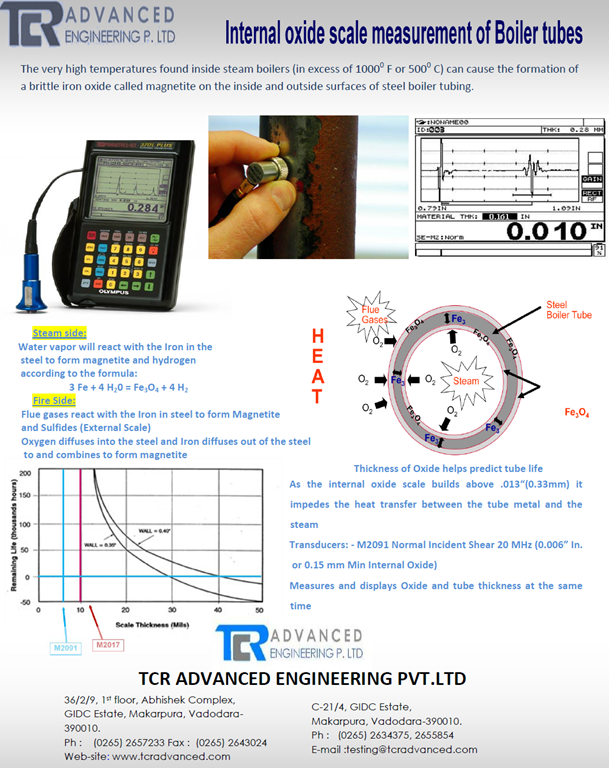
TCR Advanced conducts internal oxide scale measurement of boiler tubes
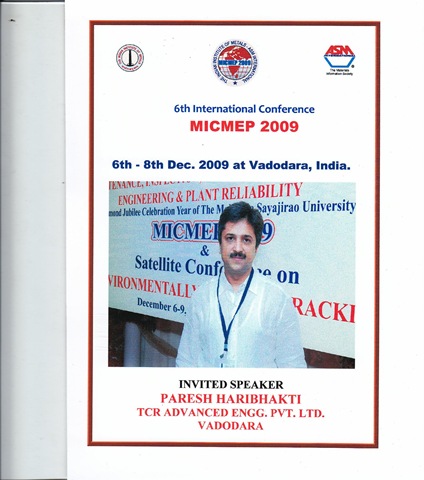
Mr. Paresh Haribhakti spoke on Root Cause Failure Investigation and Remaining life assessment of Reformer tubes
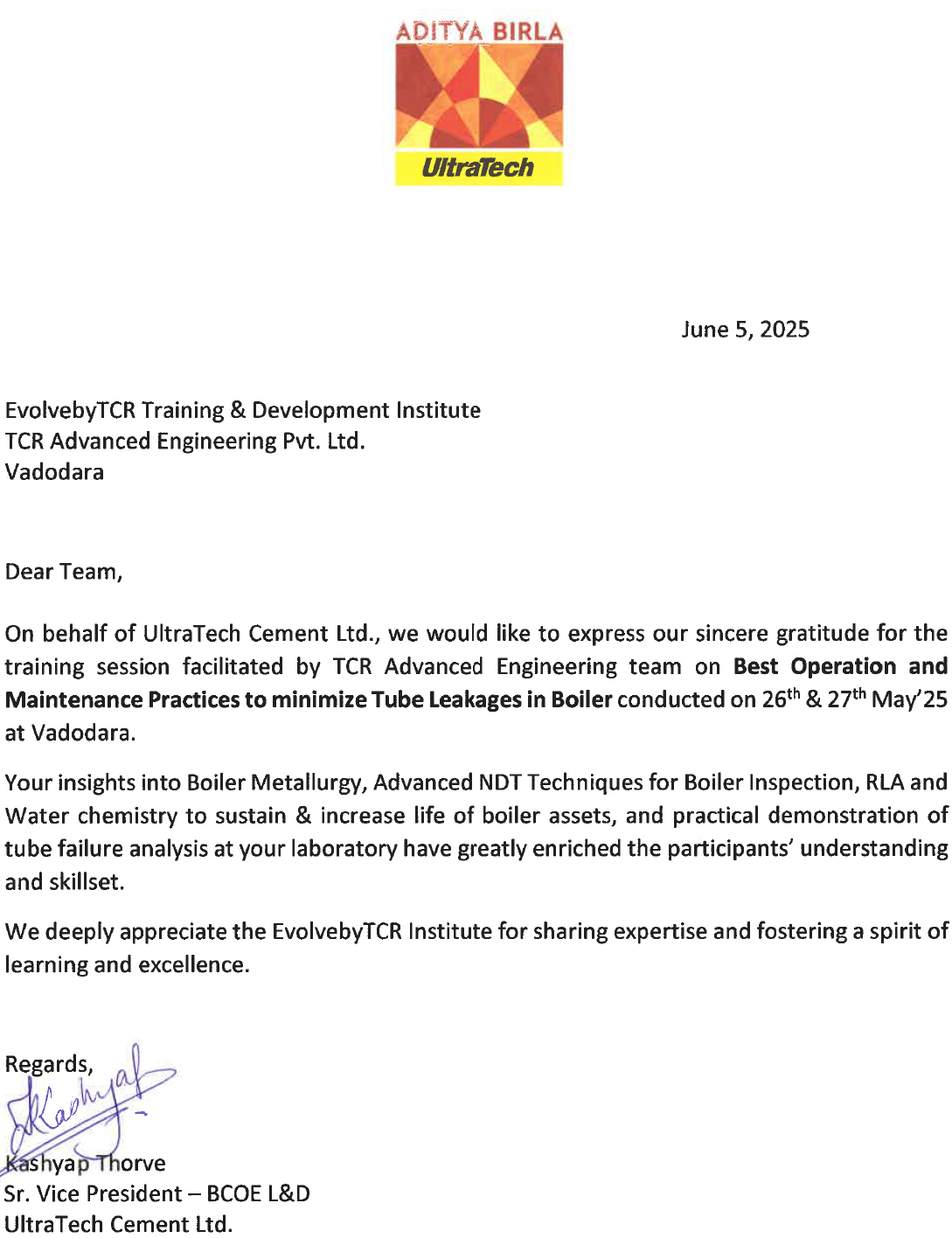
Evolve by TCR Advanced earns praise from Ultratech Cement for a high-impact training on boiler tubes and failure prevention techniques.
Download the reference documents for this page. Every file is hosted on this domain and is also listed in the site document library.
The current crawler generation accommodates reformer tube outer diameters of 70 mm to 200 mm, and the earlier generation covered 105 mm to 190 mm, together spanning fertiliser and refining reformer sizes. Wall thicknesses of 8 mm to 20 mm are covered, with full tube length traversed in a helical scan and a climb of up to 15,000 mm.
ARTiS runs ultrasonics in transmit-receive mode and measures the energy lost to beam scatter through the tube wall. TCR reads the attenuation against calibrated bands: 35 to 55 dB for virgin structure, 55 to 62 dB for aged structure, and 62 to 72 dB at a life fraction of 80 to 95 percent.
The Level 3 assessment per API 579-1/ASME FFS-1 reports accumulated creep damage for every tube, the calculated effective tube metal temperature, projected creep damage to the next shutdown, the replacement date at which damage exceeds the 0.8 life fraction, and the remaining life of each tube.
ARTiS inspects 100 tubes in about 2 days against 4 to 5 days manually, removes the scaffolding requirement, reports continuously at 100 mm resolution rather than in six-foot segments, measures outer diameter every 100 mm, and returns a quantitative bowing figure of 5 to 200 mm rather than a visual estimate.