Creep Rupture Testing of SUPER 304H as per BHEL spec in India
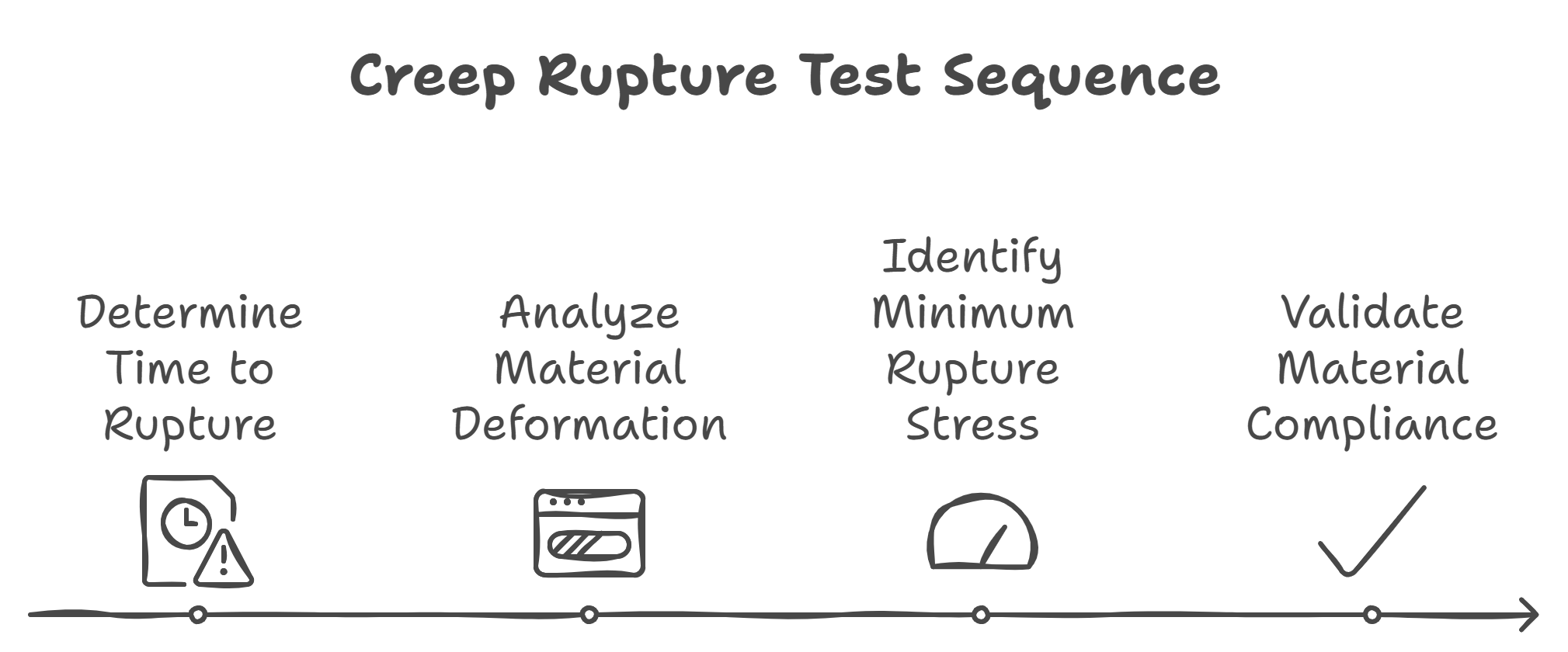
Creep Rupture Test for SUPER 304H (UNS S30432) grade materials per BHEL specifications, IBR requirements, ASTM E139, BS EN ISO 204.

Group
Services · Materials Testing
Accelerated Creep Rupture Testing, parameterised through the Larson-Miller relation, shortens the route to a defensible life estimate and feeds remaining-life and fitness-for-service work on boilers, gas turbines and reformer tubes under API 530 and API 579.
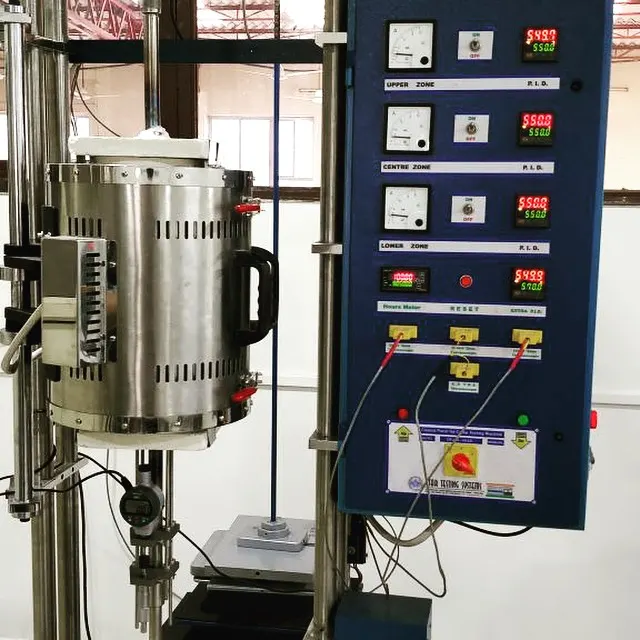
Long-duration creep and stress rupture testing per ASTM E139 and ASTM E292. Temperature range 400 degrees Celsius to 1,100 degrees Celsius. Load range 1 kN to 100 kN. Six constant-load creep frames at 50 kN, operating up to 1,100 degrees Celsius, with duration capability up to 100,000 hours.
The international peer set typically runs two or three frames at most with a 700-degree Celsius ceiling.
Methods also include IS 3407 and ISO 204, with Accelerated Creep Rupture Testing (ACRT) feeding the remaining-life assessment programme for boilers, gas turbines, and reformer tubes.
TCR Engineering provides advanced testing solutions for evaluating high-temperature material behaviour through Creep, ACRT and Stress Rupture Testing, essential for industries where equipment operates under extreme heat and stress. These tests deliver critical insights into material durability, making them invaluable for applications in boilers, gas turbines, jet engines, ovens, and other high-temperature environments.
Understanding Creep and Stress Rupture
TCR's Testing Capabilities
TCR Engineering is equipped to conduct the following tests in strict adherence to international standards, such as ASTM E139, E292, IS 3407, and ISO 204:
ACRT is increasingly popular in industries for its time-saving benefits. Using the Larson-Miller equation to derive initial test parameters, ACRT enables a faster, efficient way to estimate material life. Results from ACRT are particularly valuable for Remaining Life Assessments (RLA) and Fitness-for-Service (FFS) analyses of boilers, conducted in line with API 530 and API 579-1/ASME FFS-1.
Key Benefits of TCR’s Creep and Stress Rupture Testing
By leveraging TCR Engineering’s expertise in Creep, Stress Rupture, and ACRT testing, clients gain vital data for high-temperature component design and risk mitigation.
Applications: power-plant steam-pipe qualification, reformer-tube material validation, turbine blade material assessment, supercritical and ultra-supercritical fossil-power qualification.
Standards: ASTM E139 (creep and stress rupture), ASTM E292 (notch rupture), ASTM E328 (stress relaxation), ASTM E633 (thermocouple reference). IS 3407. ISO 204.
9 of the 135 published insights tagged to Materials Testing bear directly on Creep and Stress Rupture. The 6 most relevant are below.
Creep Rupture Test for SUPER 304H (UNS S30432) grade materials per BHEL specifications, IBR requirements, ASTM E139, BS EN ISO 204.
Testing Material Performance at High Temperatures per BS EN10002, ASTM E21, ISO 6892 and IS 1608
Ensures that materials can handle the rigors of extreme environments and prolonged stress.
NABL-accredited ASTM G47 and G44 stress corrosion cracking testing for aerospace aluminium alloys at TCR Engineering, Navi Mumbai.
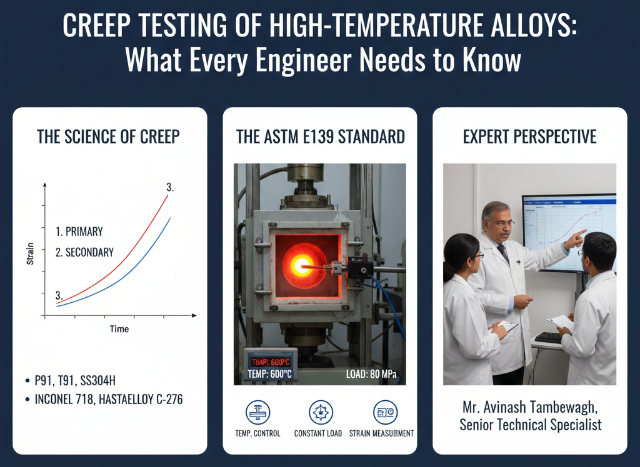
Creep testing of high-temperature alloys explained — process, ASTM E139, common mistakes, and how TCR Engineering delivers reliable long-duration…
TCR launches Residual Stress Measurement by XRD as per ASTM E2860-20—precision-driven, non-destructive, and standards-compliant.
Creep testing measures progressive deformation of a tensile specimen under constant load and temperature, recording strain over time to determine the creep rate. Stress rupture testing applies a higher stress and runs until failure, directly determining time-to-failure and elongation, with results plotted to provide material strength parameters for design.
Testing runs from 400 degrees Celsius to 1,100 degrees Celsius across a load range of 1 kN to 100 kN. Six constant-load creep frames operate at 50 kN up to 1,100 degrees Celsius, with duration capability up to 100,000 hours for long-term creep and stress rupture programmes.
ACRT uses the Larson-Miller equation to derive initial test parameters and estimate material life faster than conventional creep testing. Its results feed Remaining Life Assessment and Fitness for Service evaluations of boilers, gas turbines and reformer tubes, conducted in line with API 530 and API 579-1/ASME FFS-1.
Creep and stress rupture testing follows ASTM E139, notch rupture follows ASTM E292, stress relaxation follows ASTM E328, and thermocouple practice follows ASTM E633, alongside IS 3407 and ISO 204. Applications include power-plant steam-pipe qualification, reformer-tube validation, turbine blade assessment and supercritical fossil-power qualification.