
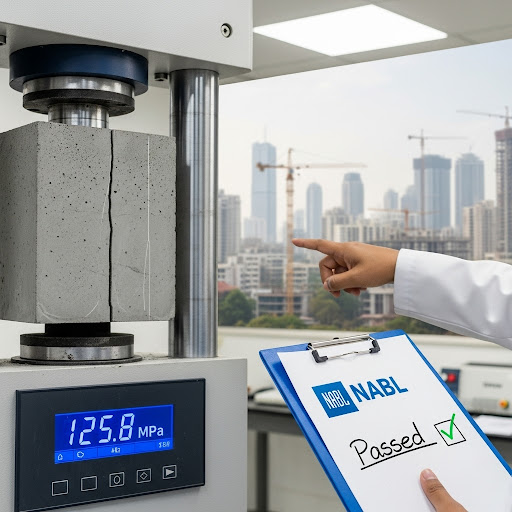
NABL accredited concrete cube compressive strength testing Mumbai contractors need isn't just another compliance checkbox. You know that moment when you're standing in front of a half-built structure, and someone asks: "Are we sure this concrete can handle the load?" That question hits differently when it's your project, your timeline, and your reputation on the line.
Here's what really keeps Mumbai construction managers awake at night: knowing whether their concrete actually meets design specifications before problems show up. The difference between proper testing and hoping for the best? About ₹50 lakhs in potential delays and rework costs.
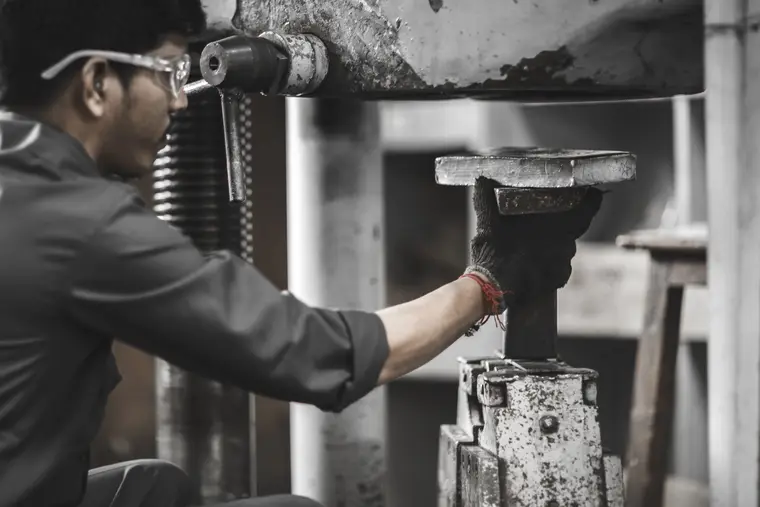
Why Most Mumbai Construction Projects Get Concrete Testing Wrong
Let's talk about what happened at a major residential project in Bandra last year. The developer thought they were doing everything right. They had concrete suppliers with certifications. Regular visual inspections looked fine. But when CIDCO demanded proper NABL-accredited test results, the numbers told a different story: 28-day compressive strength, 15% below design specifications.
The result? Three months of delays, partial reconstruction, and costs spiralling past ₹3 crores. This isn't rare in Mumbai's construction landscape. Most projects still rely on suppliers' certificates or non-accredited testing that doesn't hold up under regulatory scrutiny.
The Real Cost of Non-NABL Testing in Mumbai Construction
What Changed Everything. Remember when construction quality testing meant taking the supplier's word for it? Those days ended when CIDCO, MMRDA, and other Mumbai authorities started demanding NABL-accredited results. Now it's simple: no NABL certificate, no approval.
But here's where it gets expensive: most contractors discover this after they've already poured concrete. Testing non-NABL concrete after the fact means:
- Core cutting from existing structures
- Destructive testing requirements
- Potential structural repairs
- Project delays while waiting for results
- Regulatory non-compliance issues
Where Most Mumbai Projects Go Wrong. The biggest mistake? Thinking all concrete testing is the same. NABL accredited concrete cube compressive strength testing Mumbai facilities provide isn't just about getting numbers — it's about getting legally admissible results that regulatory bodies will accept without question. Non-NABL testing might be cheaper upfront, but when CIDCO or MMRDA rejects your submissions, that ₹500 saving per test becomes a ₹5 lakh problem.
TCR Engineering: Mumbai's Most Trusted NABL Accredited Concrete Testing Laboratory
Five Decades of Mumbai Construction Excellence. TCR Engineering Services has been Mumbai's go-to testing laboratory since 1973 — 50 years of serving Mumbai's construction industry. Not as another testing facility, but as the trusted partner that major developers rely on when projects absolutely cannot fail.
What Makes TCR Different: Triple Accreditation Advantage
While most labs have basic NABL accreditation, TCR Engineering Services maintains:
- NABL accreditation (legally required)
- ISO 17025 international certification (quality assurance)
- BIS approval (Indian Standards compliance)
This triple certification means every test result meets not just Indian requirements, but international standards.
Mumbai-Specific Expertise
Having worked on several Mumbai construction projects, TCR Engineering Services understands local challenges:
- High humidity effects on concrete curing
- Monsoon season testing protocols
- CIDCO and MMRDA specific requirements
- Local aggregate characteristics
- Transportation challenges in Mumbai traffic
Real Mumbai Success Stories
Case Study 1: Antillia Project. TCR Engineering Services provided complete NDT services for Mumbai's most prestigious residential tower. Result: zero structural issues, timely completion, full regulatory approval.
Case Study 2: Wankhede Stadium Renovation. Critical structural analysis during major renovations required absolute precision. TCR's NABL-accredited testing ensured public safety while maintaining the iconic structure's integrity.
Case Study 3: Mumbai 3.0 Infrastructure Preparation. With CIDCO approval secured, TCR Engineering Services is positioned to support the ambitious Navi Mumbai Airport Influence Notified Area (NAINA) project. This mega project, transforming 270 villages across Thane and Raigad districts into modern urban infrastructure, requires:
- Quality assurance for commercial complexes and data centres
- Material testing for multinational corporation hubs
- Compliance testing for residential zones
- Infrastructure validation for knowledge parks
Result: pre-approved status eliminates testing delays for contractors working on Mumbai 3.0 projects.
Complete Concrete Cube Compressive Strength Testing Mumbai Services
Standard Cube Testing Protocol
28-Day Compressive Strength Testing
- Sample collection as per IS 1199:1959
- Cube preparation following IS 10086:1982
- Curing in standard conditions (27±2°C)
- Testing using calibrated compression machines
- Digital reporting with NABL certification
7-Day Intermediate Testing
- Early strength assessment
- Quality control during construction
- Mix design validation
- Troubleshooting weak batches
3-Day Accelerated Testing
- Emergency quality verification
- Fast-track project support
- Mix adjustment guidance
- Critical path timeline support
Advanced Concrete Testing Services
Beyond basic cube testing, TCR Engineering Services offers comprehensive civil testing including temperature monitoring, durability testing, fresh concrete properties and specialised testing.
Temperature Monitoring Excellence. TCR Engineering Services provides critical on-site concrete temperature monitoring — a service that separates professional contractors from amateur builders.
Why temperature monitoring matters in Mumbai:
- Mumbai's extreme heat (35–42°C summers) affects concrete curing
- Monsoon temperature variations impact strength development
- High-rise construction requires precise temperature control
- Mass concrete pours need continuous monitoring
TCR's temperature monitoring technology:
- Embedded thermocouple sensors in concrete mix
- Real-time data capture throughout curing process
- Compliance with ASTM C1064 and C1074 standards
- ACI 305 (Hot Weather) and ACI 306 (Cold Weather) protocols
Critical applications:
- Mass concrete pours (basements, foundations)
- High-performance concrete applications
- Critical load-bearing elements
- Hot climate zone construction
Durability Testing: water permeability assessment, chloride penetration resistance, carbonation depth analysis, freeze-thaw resistance evaluation.
Fresh Concrete Properties: slump testing for workability, air content measurement, temperature monitoring during placement, setting time determination.
Specialized Testing: high-strength concrete (>60 MPa), self-compacting concrete assessment, fibre-reinforced concrete evaluation, ready-mix concrete validation.
Engineering Standards That Actually Matter in Mumbai
IS Standards Compliance
- IS 456:2000 – Plain and Reinforced Concrete: design mix requirements, quality control standards, acceptance criteria for strength
- IS 10262:2019 – Concrete Mix Proportioning: mix design guidelines, material specification requirements, performance-based specifications
- IS 1199:1959 – Methods of Sampling and Analysis: proper sampling techniques, representative sample collection, chain of custody protocols
International Standards Integration
- ASTM C39 – Compressive Strength Testing: standard test method alignment, international project requirements, export certification support
- BS EN 12390 – European Standards: European project compliance, international contractor requirements, global certification support
NABL Document Requirements
- NABL 112 – Testing Laboratory Requirements: quality management system compliance, technical competence demonstration, measurement traceability assurance
- NABL 121 – Specific Criteria for Civil Engineering: construction material testing requirements, concrete testing specific protocols, documentation and reporting standards
Mumbai Location Advantages: Why Local Testing Matters
Strategic Laboratory Locations. Primary Mumbai lab at VKB House, MIDC-TTC Electronic Zone, Mahape — a state-of-the-art concrete testing facility with quick turnaround for Mumbai projects and easy access from the Western and Eastern Express Highways.
Sample Collection Network: delivery/pickup collection point for Western suburbs, delivery/pickup for Northern Mumbai, Lower Parel registered office for South Mumbai, and specialised cold-chain transport for critical samples.
Mumbai Traffic Solutions. Understanding Mumbai's logistics challenges, TCR Engineering Services offers morning collection schedules (6–8 AM) avoiding peak traffic, dedicated sample transport vehicles with temperature control, multiple collection points reducing travel time, and express testing services for critical path projects.
Local Regulatory Expertise
CIDCO Approval: A Game-Changer for Mumbai Construction. TCR Engineering Services recently secured CIDCO approval, a significant milestone that positions it as one of the few external material testing laboratories (eMTLs) authorised for infrastructure projects.
Why CIDCO approval matters for your project:
- Mandatory for all CIDCO infrastructure projects
- Pre-approved testing laboratory status
- Eliminates approval delays and bureaucratic hurdles
- Direct access to Mumbai 3.0 mega projects
Mumbai 3.0 Project Opportunities. With CIDCO's ambitious Navi Mumbai Airport Influence Notified Area (NAINA) transforming 270 villages across Thane and Raigad districts, TCR Engineering Services is positioned to support commercial complexes and data centres, multinational corporation hubs, residential zones development, knowledge parks construction, and infrastructure connectivity projects.
MMRDA Integration. Following the administrative restructuring where the New Town Development Authority (NTDA) under MMRDA took over planning authority, TCR Engineering Services provides Metro project concrete testing, Mumbai Trans-Harbour Link (MTHL) material validation, bridge construction compliance testing, and tunnel construction materials assessment.
BMC Requirements: municipal building approvals, road construction materials testing, public infrastructure compliance, heritage building restoration testing.
Turnaround Times That Work for Mumbai Projects
Standard Testing Schedule:
- 7-day results: available within 8 days of casting
- 28-day results: available within 30 days of casting
- Digital reports: same day as testing completion
- NABL certificates: included with all reports
Mumbai Project Economics — Cost-Benefit Analysis:
- NABL testing investment: ₹1,200 per batch
- Non-compliance penalty: ₹50,000 – ₹5,00,000
- Project delay costs: ₹10,000 per day
- Rework expenses: ₹500 per cubic metre
ROI Calculation. For a 10,000 cubic metre concrete project: total testing investment ₹1,50,000; risk mitigation value ₹50,00,000+; return on investment 33:1.
Real Client Testimonials from Mumbai Projects
Major Residential Developer (Bandra Project): "After a poor experience with non-NABL testing causing CIDCO approval delays, switching to TCR Engineering was a game-changer. Their reports were accepted immediately, saving us 3 months and ₹2 crores in potential delays."
Infrastructure Contractor (Mumbai Metro): "TCR's understanding of MMRDA requirements and their ability to deliver results within Mumbai's tight timelines has made them our go-to testing partner for all metro projects."
Commercial Builder (Andheri Project): "The difference between TCR's NABL-accredited reports and our previous lab's certificates was obvious when BMC reviewed our submissions. TCR's reports sailed through approval while others were rejected."
Advanced Technology: Why TCR's Testing Is More Accurate
State-of-the-Art Equipment — Compression Testing Machines: 3000 kN capacity for high-strength concrete, digital load control and data acquisition, calibrated to NABL standards, real-time data recording.
Environmental Controls: temperature-controlled curing rooms (27±2°C), humidity monitoring systems (>90% RH), automated curing protocols, concrete temperature monitoring capabilities.
Sample Preparation: automated cube moulding systems, vibration tables for proper compaction, surface finishing equipment, chain of custody tracking.
Quality Assurance Protocols. Internal quality control: daily calibration checks, reference sample testing, round-robin testing participation, proficiency testing compliance. External validation: NABL surveillance audits, inter-laboratory comparisons, customer audit compliance, international accreditation maintenance.
Comprehensive Construction Materials Testing Integration
Beyond concrete cubes, TCR Engineering Services provides complete construction materials testing:
- Cement Testing – chemical composition analysis, physical property assessment, fineness and consistency testing, setting time evaluation
- Aggregate Testing – gradation analysis, specific gravity determination, water absorption testing, impact and crushing value
- Steel Testing – reinforcement bar testing, coupler testing services, weld testing and qualification, material identification
- Admixture Testing – chemical admixture evaluation, performance testing, compatibility assessment, quality control validation
Specialized Mumbai Services
Temperature-Critical Construction. Mumbai's challenging climate demands specialised expertise. TCR Engineering Services provides summer construction protocols (35–42°C management), monsoon season concrete protection, real-time temperature monitoring systems, and thermal cracking prevention strategies.
Advanced curing solutions: climate-controlled curing rooms (27±2°C), humidity management systems (>90% RH), automated temperature logging, emergency cooling protocols for mass pours.
High-Rise Construction Support: pumped concrete testing, high-strength mix validation, quality control at height, specialised sampling techniques.
Marine Environment Testing: chloride resistance assessment, coastal construction protocols, durability in salt exposure, long-term performance prediction.
Digital Reporting and Documentation Excellence
Modern Reporting Systems. Digital-first approach: cloud-based report delivery, real-time test status updates, mobile-friendly report access, automated compliance tracking. Comprehensive documentation: detailed test methodologies, statistical analysis included, trend analysis for ongoing projects, historical data comparison. Regulatory compliance: NABL logo and certification numbers, authorised signatory validation, traceability documentation, legal admissibility assurance.
Project Management Integration. Dashboard access: real-time project status, test result summaries, compliance tracking, cost management tools. Alert systems: failed test notifications, compliance deadline reminders, sample collection scheduling, result delivery confirmations.
Mumbai Construction Industry Insights
Market Trends and Challenges. Regulatory evolution: CIDCO and MMRDA are continuously updating requirements, including mandatory NABL testing for all projects >5,000 sq ft, digital submission requirements, enhanced documentation standards, and stricter penalty enforcement. Quality expectations: modern Mumbai construction demands higher strength concrete (M30–M60 grades), improved durability requirements, environmental compliance, and sustainable construction practices.
Future-Ready Testing Services. Emerging technologies: AI-powered result analysis, IoT-enabled monitoring systems, blockchain documentation, predictive maintenance protocols. Sustainability focus: green concrete testing, recycled aggregate evaluation, carbon footprint assessment, eco-friendly material validation.
Making the Right Choice: TCR vs. Competitors
Comparison Matrix — TCR Engineering vs. Non-NABL Labs: legal validity (guaranteed acceptance vs. potential rejection); quality (ISO 17025 assured vs. variable); risk (zero regulatory risk vs. high compliance risk); cost (higher upfront, massive savings long-term).
Decision Criteria
- For Large Developers – regulatory compliance assurance, bulk testing capabilities, project management integration, reputation and track record
- For Contractors – quick turnaround times, competitive pricing, multiple location convenience, technical support availability
- For Consultants – technical expertise depth, specialised testing capabilities, professional reporting quality, continuing education support
Taking Action: Your Next Steps for Mumbai Construction Success
The reality about Mumbai construction is straightforward. Regulatory bodies won't compromise on quality documentation. CIDCO, MMRDA, and BMC have made NABL-accredited testing mandatory for good reason. Every month of delay costs ₹10,000+ per day in most Mumbai projects. Every rejected submission means weeks of additional approvals.
For projects serious about timely completion and regulatory compliance, the choice is clear. TCR Engineering Services transforms construction quality from a compliance headache into a competitive advantage. With 50 years of Mumbai construction experience, triple accreditation, and the city's most competitive pricing, we ensure your concrete cube compressive strength testing Mumbai requirements become your project's strongest foundation.
Contact TCR Engineering Services today at +91-9833530200 or email sales@tcreng.com to discuss how NABL accredited concrete cube compressive strength testing Mumbai standards can secure your construction project's success.
Frequently Asked Questions
Q: How long does NABL accredited concrete cube compressive strength testing take in Mumbai?
A: Standard results are available in 7 days (for 7-day strength) and 28 days (for 28-day strength) from casting date. TCR Engineering Services offers express 24-hour results for ₹600 per cube when needed for critical projects.
Q: What's the difference between NABL and non-NABL concrete testing?
A: NABL-accredited results are legally admissible and accepted by all regulatory bodies like CIDCO, MMRDA, and BMC. Non-NABL results may be rejected, leading to costly retesting and project delays. TCR's NABL accreditation ensures your results are accepted first time, every time.
Q: Can TCR Engineering Services handle large Mumbai construction projects?
A: Absolutely. With 50+ years of experience, TCR has supported projects from Antillia to Wankhede Stadium, handling hundreds of samples monthly. Our multiple Mumbai locations and dedicated logistics ensure no project is too large.
Q: What happens if concrete fails compressive strength testing?
A: TCR Engineering Services provides detailed failure analysis, identifies root causes, and recommends corrective actions. Our metallurgical expertise helps determine whether issues are material-related, mix design, or curing problems.
Q: Does TCR provide testing services during Mumbai monsoons?
A: Yes, our climate-controlled facilities operate year-round. We have specialised monsoon protocols for sample collection and curing during Mumbai's rainy season, including advanced concrete temperature monitoring to ensure proper hydration despite weather challenges.
Q: Is TCR Engineering Services approved by major Mumbai regulatory bodies?
A: TCR holds official CIDCO approval as an external material testing laboratory (eMTL), along with NABL, ISO 17025, and BIS certifications. We're pre-approved for Mumbai 3.0 projects and our reports are accepted by MMRDA, BMC, and other Mumbai construction authorities without additional verification.
Q: Can I track my concrete test results online?
A: Yes, TCR provides digital reporting with real-time status updates. All results are delivered electronically with NABL certificates, and historical data is accessible through our client portal.