Reformer tube inspection services petrochemical facilities need aren't just another maintenance checkbox.
You know that sinking feeling when production suddenly drops, and everyone's scrambling to figure out why?
Nine times out of ten, it's tubes.
The reformer tubes that quietly handle your most critical processes until they don't.
Here's what really keeps plant managers up at night: knowing when those tubes will fail versus when they actually do.
The difference between these two scenarios can mean the difference between planned maintenance costing ₹50 lakhs and emergency shutdowns costing ₹5 crores.
What Actually Happens When Reformer Tubes Go Wrong
Let's talk about what happened at a major Indian petrochemical facility last year.
Everything seemed normal during their routine inspection.
Standard visual checks looked fine.
But three months later, catastrophic tube failure.
The culprit? Creep damage that had been building for years, completely invisible to traditional inspection methods.
This isn't an isolated incident.
The real problem isn't tube failure itself - it's not knowing it's coming.
Most facilities are still using inspection methods from the 1990s for problems that have evolved significantly.
Traditional approaches miss the early warning signs that modern technology can catch months, even years ahead of time.
The Evolution of Reformer Tube Inspection Services in Petrochemical Plants
What Changed Everything
Remember when mechanical testing meant basic visual inspection and thickness measurement?
Those days are gone.
Modern reformer tubes operate under conditions our predecessors never imagined:
- Higher temperatures (900-1000°C)
- Increased pressure demands
- Longer run cycles
- More aggressive feedstock
The old methods simply can't keep up.
Where Most Facilities Go Wrong
Here's where it gets interesting.
Most petrochemical plants are still thinking about tube inspection as a binary problem: working or broken.
But tube degradation is a continuous process.
Creep damage doesn't happen overnight.
It builds gradually, creating internal voids that eventually link together into fissures.
By the time traditional methods detect these issues, you're already in crisis mode.
ARTiS: TCR Engineering's Game-Changing Approach to Reformer Tube Inspection
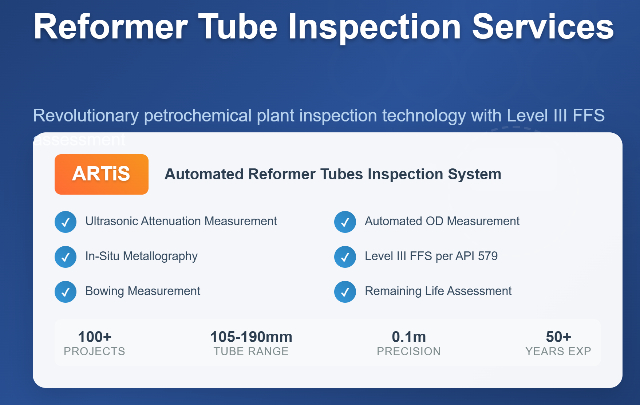
TCR Engineering Services developed ARTiS (Automated Reformer Tubes Inspection System) specifically to solve this problem.
Not as another inspection tool, but as a complete condition assessment system.
What Makes ARTiS Different
Multi-technique Integration
Instead of relying on one method, ARTiS combines:
- Ultrasonic attenuation measurement for fissure detection
- Automated outer diameter measurement with infrared sensors
- Bowing measurement with electronic devices
- In-situ metallography for microstructural analysis
- Visual inspection by experts
- Hardness testing at metallography locations
- Magnetic permeability measurement
The Real Innovation: Fitness for Service Assessment
This is where TCR Engineering Services really separates from the pack.
Every ARTiS inspection includes Level III FFS assessment per API 579/ASME FFS1.
What does this mean practically?
Instead of guessing when tubes need replacement, you get:
- Exact accumulated creep damage calculations
- Effective tube metal temperature determination
- Projected creep damage up to next shutdown
- Specific retirement dates when accumulated creep damage exceeds 0.8 life fraction
- Individual remaining life assessment for each tube
How ARTiS Actually Works in Practice
The automated crawler accommodates tube outer diameters from 105mm to 190mm.
It moves systematically through your reformer, taking measurements every 0.1 meter.
But here's what makes it special: proprietary standard samples with known damage scenarios.
This gives TCR Engineering Services a massive advantage over other inspection methods.
When ARTiS detects an anomaly, it's compared against a database of over 100 previous assessments from Indian and international facilities.
The Engineering Standards That Actually Matter
API 579/ASME FFS1: The Gold Standard
Most facilities know about API 579/ASME FFS1 but don't really understand what Level III assessment means.
Level III is the most comprehensive analysis available.
It requires:
- Detailed stress analysis
- Material property evaluation
- Crack growth analysis
- Remaining life calculations
TCR Engineering Services provides complete Level III assessments, not the simplified Level I or II evaluations most companies offer.
ISO 17025 and NABL Accreditation
Here's why this matters more than you might think.
ISO 17025 accreditation means:
- Documented quality management system
- Technically competent personnel
- Valid test methods
- Traceable measurements
- Reliable results
TCR Engineering Services maintains both ISO 17025 and NABL accreditation, ensuring every result meets international standards.
Real-World Results: Where ARTiS Makes the Difference
Case Study: Major Indian Refinery
One of IOCL's facilities was planning complete tube replacement based on age.
ARTiS assessment revealed:
- 60% of tubes had significant remaining life
- Only 15% needed immediate replacement
- Optimised replacement schedule saved ₹12 crores
International Success: PEMEX Salamanca
At PEMEX Refinery Salamanca, Mexico, traditional inspection suggested widespread tube replacement.
ARTiS identified specific failure mechanisms and provided targeted solutions.
Result: Extended safe operation by 18 months with selective replacements.
The Technology Behind Superior Reformer Tube Inspection
Ultrasonic Attenuation: The Early Warning System
Here's something most people don't understand about creep damage.
It starts with microscopic voids at dendrite boundaries.
These voids are invisible to visual inspection and too small for standard ultrasonic thickness measurement.
But they change how ultrasonic waves propagate through the material.
ARTiS measures attenuation in decibels (dB):
- Unused tubes: 35-55 dB
- Aged structures: 55-62 dB
- Near end-of-life: 62-72 dB
- Critical condition: >70 dB
This gives you months or years of advance warning.
Automated Diameter Measurement: Precision That Matters
Creep causes gradual diameter expansion.
Manual measurements are inconsistent and miss gradual changes.
ARTiS uses infrared sensors to measure outer diameter automatically at 0.1-meter intervals.
This creates a complete picture of creep strain distribution throughout each tube.
In-Situ Metallography: Seeing What Others Miss
Traditional metallography requires cutting samples from tubes.
This means:
- Limited sampling points
- Destructive testing
- Time-consuming laboratory analysis
ARTiS performs in-situ metallography directly on operating tubes.
This reveals:
- Microstructural degradation
- Carbide coarsening
- Creep void formation
- Secondary carbide precipitation
Cost-Benefit Analysis: What ARTiS Really Costs vs. What It Saves
Traditional Approach Costs
Most facilities using conventional inspection methods face:
- Unplanned shutdowns: ₹2-5 crores per incident
- Emergency tube replacement: 3-4x normal costs
- Extended downtime: ₹10-15 lakhs per day
- Safety incidents: Incalculable
ARTiS Investment Returns
Comprehensive ARTiS assessment typically costs ₹15-25 lakhs.
But consider the returns:
- Avoiding one unplanned shutdown pays for 10+ ARTiS assessments
- Optimised replacement schedules reduce tube costs by 40-60%
- Extended safe operation increases profitability
- Regulatory compliance reduces liability
The Real ROI: Predictable Operations
The biggest benefit isn't cost savings - it's predictability.
When you know exactly when tubes need replacement, you can:
- Plan maintenance windows
- Coordinate with catalyst replacement
- Optimise inventory management
- Schedule workforce efficiently
Comprehensive Service Integration: Beyond Just Inspection
Failure Analysis and Root Cause Investigation
When tubes do fail, understanding why prevents future failures.
TCR Engineering Services combines:
- Metallographic analysis
- Chemical composition verification
- Operating condition analysis
- Design review
Asset Integrity Management
ARTiS inspection is part of broader asset integrity management.
This includes:
- Pipeline integrity assessment
- Storage tank inspection
- Boiler audit services
- Cathodic protection evaluation
Industry Applications: Where ARTiS Delivers Results
Refineries and Petrochemicals
Major clients include:
- Indian Oil Corporation Ltd. (multiple refineries)
- Hindustan Petroleum Corporation Ltd.
- Bharat Petroleum Corporation Ltd.
- NAYARA Energy
- International facilities in Mexico, Nigeria, Indonesia
Fertilizer and Chemical Plants
Specialized applications for:
- Gujarat Narmada Valley Fertilizers & Chemicals Ltd.
- Deepak Fertilizers & Chemicals Ltd.
- Chambal Fertilizers & Chemicals Ltd.
- Rashtriya Chemicals & Fertilizers Ltd.
Power Generation
Steam reformer inspection for:
- Combined cycle plants
- Hydrogen production facilities
- Syngas generation units
Advanced NDT Integration: Complete Inspection Solutions
Complementary Testing Methods
ARTiS works alongside other advanced NDT services:
Time of Flight Diffraction (ToFD)
- Precise crack sizing
- Volumetric examination
- Permanent record keeping
Phased Array Ultrasonic Testing (PAUT)
- Multiple angle examination
- Real-time imaging
- Enhanced detection capabilities
Eddy Current Testing
- Surface and near-surface defects
- Heat exchanger tube inspection
- Material property verification
Heat Treatment and Repair Integration
When ARTiS identifies issues requiring intervention:
- PWHT heat treatment services
- Repair procedure development
- Post-repair verification testing
Quality Assurance: Why Certification Matters
NABL Accreditation Benefits
National Accreditation Board for Testing and Calibration Laboratories (NABL) accreditation ensures:
- International recognition
- Legal admissibility
- Quality consistency
- Continuous improvement
ISO 17025 Compliance
International standard for testing laboratory competence guarantees:
- Technical competency
- Management system effectiveness
- Measurement traceability
- Result reliability
Third-Party Verification
All ARTiS assessments undergo:
- Independent review
- Data validation
- Report verification
- Continuous monitoring
Training and Workforce Development
Specialized Personnel
ARTiS operation requires:
- Level III certified inspectors
- Metallurgical specialists
- FFS assessment experts
- Data analysis professionals
Continuous Education
TCR Engineering Services provides:
- Equipment operation training
- Result interpretation guidance
- Best practices sharing
- Technical support
Future Trends in Reformer Tube Inspection
Digital Integration
Modern inspection moves toward:
- Cloud-based data storage
- Predictive analytics
- Machine learning integration
- Remote monitoring capabilities
Automated Reporting
Advanced systems provide:
- Real-time data transmission
- Automated report generation
- Historical trend analysis
- Predictive maintenance scheduling
Making the Right Choice: Evaluation Criteria
Technical Capabilities
When selecting reformer tube inspection services, consider:
- Multi-technique integration
- FFS assessment capability
- Standards compliance
- Historical database access
Experience and Track Record
Look for providers with:
- Extensive facility experience
- International project exposure
- Diverse industry knowledge
- Proven results documentation
Service Integration
Choose providers offering:
- Complete inspection solutions
- Failure analysis capabilities
- Repair and maintenance services
- Long-term partnership approach
Frequently Asked Questions
Q: How often should reformer tubes be inspected using ARTiS?
A: Typically every 2-4 years during planned shutdowns, depending on operating conditions and tube age. High-temperature or high-pressure operations may require more frequent assessment.
Q: Can ARTiS detect problems that visual inspection misses?
A: Absolutely. ARTiS detects internal creep damage months or years before it becomes visible. Visual inspection only catches advanced degradation when replacement is already urgent.
Q: What's the difference between Level I, II, and III FFS assessment?
A: Level I uses simplified calculations, Level II involves more detailed analysis, and Level III provides comprehensive stress analysis with precise remaining life calculations. TCR provides Level III assessments.
Q: How accurate are the remaining life predictions?
A: ARTiS predictions typically have ±10% accuracy for tubes with significant remaining life. Accuracy improves as more operational data becomes available.
Q: Can ARTiS inspect all reformer tube materials?
A: Yes, ARTiS works with all common reformer tube alloys including HP, HP-Modified, IN519, IN617, and others up to 23mm wall thickness.
Q: What documentation is provided after ARTiS inspection?
A: Complete reports include inspection results, FFS assessment per API 579, individual tube conditions, replacement schedules, and cost-benefit analysis.
Q: How does ARTiS compare to international inspection methods?
A: ARTiS incorporates best international practices while being optimised for Indian operating conditions and regulatory requirements. It meets or exceeds international standards.
Q: Can ARTiS inspection be performed during operation?
A: No, reformer tubes must be shut down and cooled for safe inspection. However, the inspection process is highly efficient, minimising downtime.
Taking Action: Next Steps for Your Facility
The reality is straightforward.
Your reformer tubes will eventually need replacement.
The question isn't if, but when.
And whether you'll know about it ahead of time or discover it during an emergency shutdown.
ARTiS gives you that advance knowledge.
It transforms reactive maintenance into predictive asset management.
For facilities serious about operational reliability, the choice is clear.
Contact TCR Engineering Services to discuss how reformer tube inspection services petrochemical plants need can transform your maintenance strategy and operational reliability.