
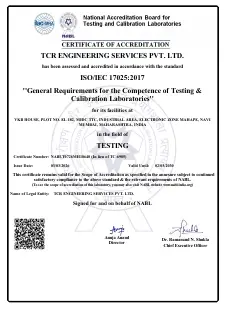
The National Accreditation Board for Testing and Calibration Laboratories has renewed TCR Engineering Services Pvt. Ltd.'s ISO/IEC 17025:2017 accreditation for its Mahape laboratory in Navi Mumbai. Certificate NABLT0726MH18640 was issued on 3 March 2026 and runs to 2 March 2030, in the field of Testing, carrying 1,483 accredited test methods across ten discipline groups. It replaces TC-6905.
What the certificate establishes:
- Accredited entity: TCR Engineering Services Pvt. Ltd., VKB House, Plot No. EL-182, MIDC TTC Industrial Area, Electronic Zone, Mahape, Navi Mumbai, Maharashtra
- Standard: ISO/IEC 17025:2017, General Requirements for the Competence of Testing and Calibration Laboratories
- Certificate number: NABLT0726MH18640, in lieu of TC-6905
- Validity: 3 March 2026 to 2 March 2030, last amended 10 July 2026
- Scope: 1,383 permanent-laboratory test methods and 100 site-testing methods, 1,483 in total, listed over a 131-page annexure
- Standards families in scope: ASTM, IS, ISO, EN, BS, IEC, AWS, API and NACE
What accreditation actually asserts, and what it does not
An ISO/IEC 17025 certificate is not a quality badge. It is a third party's finding, re-tested on a cycle, that a named laboratory is technically competent to perform a specific list of test methods on specific materials, and that its management system produces results that are traceable and defensible. The scope annexure is therefore the document that matters. A laboratory with a certificate and a thin scope can accredit very little.
The distinction has commercial consequences. A purchaser writing "NABL-accredited laboratory" into a specification is, in practice, requiring that the test they need appears as a line in that annexure against the material they are submitting and the method they have named. When TCR states that a test is accredited, it means the discipline, the material, the parameter and the method are all present as one row. Where a capability sits outside the certificate, it is stated as non-accredited. That is the honest reading and it is the one an auditor applies.
Mechanical testing: the largest single block of the scope
The mechanical properties of metals are the deepest part of the annexure and cover far more than tensile and hardness.
- Tension: room-temperature tension to ASTM A370 and ISO 6892-1, elevated-temperature tension to ASTM E21, and formability parameters including the plastic strain ratio to ISO 10113, the strain-hardening exponent to ISO 10275 and Erichsen cupping to ISO 20482
- Impact: Charpy V-notch to ASTM E23, ISO 148 and EN 10045, with sub-size and low-temperature configurations
- Hardness: Brinell to ASTM E10 and ISO 6506, Rockwell to ASTM E18 and ISO 6508, Vickers and micro-Vickers to ISO 6507, and portable UCI hardness
- Creep and stress rupture: ASTM E139 and ISO 204 for creep, ASTM E292 for stress rupture
- Fatigue: load-controlled fatigue to ASTM E466, strain-controlled low-cycle fatigue to ASTM E606/E606M, and fatigue crack growth rate to ASTM E647 and ISO 12108
- Fracture mechanics: CTOD and J-integral to ASTM E1820, ISO 12135, ISO 15653, BS 7448 and BS 8571; plane-strain fracture toughness to ASTM E399 and ISO 12737
- Weld procedure and welder qualification: transverse and longitudinal tension, bend, macro and impact tests to EN 895, EN 910, EN 875, EN 1043, ISO 4136, ISO 5173, ISO 9015, ISO 9016 and API 1104
- Rail welds and fasteners: EN 14587-1, EN 14587-2 and EN 14730-1 for rail welding; proof load and wedge tension to ISO 898
The fracture mechanics and creep rows are the ones worth pausing on. CTOD, J-integral and fatigue crack growth testing are the input to an engineering critical analysis and to a fitness-for-service assessment under API 579; creep and stress rupture feed remaining life assessment on high-temperature plant. Very few Indian commercial laboratories hold all of these under one accreditation, which is why the integrity work and the mechanical testing sit under one roof here rather than being subcontracted across three.
Chemical analysis: instrumental and wet, with the referee method beside the fast one
The chemical block covers metals and alloys by both optical emission spectrometry and classical wet chemistry, which is the combination that lets a disputed result be settled rather than argued.
- Optical emission spectrometry: ASTM E415 for carbon and low-alloy steel, ASTM E1086 for stainless steel, ASTM E1251 for aluminium and aluminium alloys
- Wet and instrumental referee methods: ASTM E350 for carbon steel, ASTM E353 for stainless and heat-resisting alloys, ASTM E354 for high-temperature alloys, ASTM E478 for copper alloys
- Gas analysis: carbon, sulphur, nitrogen, oxygen and hydrogen to ASTM E1019 by combustion and inert gas fusion
Chemical analysis also carries corrosion-side methods that a purchaser of stainless or duplex material asks for by name: intergranular corrosion to ASTM A262 and ISO 3651, ferritic grades to ASTM A763, duplex intermetallic phase detection to ASTM A923, salt spray to ASTM B117, ISO 9227 and IS 9844, copper-accelerated acetic acid salt spray to ASTM B368, exfoliation to ASTM G34, stress corrosion of aluminium to ASTM G47, NAMLT to ASTM G67, and slow strain rate testing to ASTM G129. Sour-service qualification work is described on the corrosion and sour service page.
Metallography: the discipline that explains the failure
Metallurgical evaluation is its own accredited discipline group, not a sub-heading of mechanical testing.
- Macro examination and macroetch to ASTM E340, ASTM E381 and ASTM A604/A604M
- Microstructure, grain size, inclusion rating and case depth, with inclusion assessment also to EN 10247
- Graphite classification in cast irons to ASTM A247
- Weld macro and micro examination to ISO 17639
- Ferrite measurement by ferritoscope
- Field replica microstructure examination to ASTM E1351, which is the accredited basis of the in-situ metallography service and therefore of a large part of the failure analysis casework
- Depth of carbonation in concrete to EN 14630
Non-destructive testing: accredited, and separately licensed
Non-destructive testing on metals and alloys is an accredited discipline group in its own right, covering ultrasonic testing, radiography, magnetic particle and liquid penetrant examination. It is worth being precise about what accreditation does and does not do here: ISO/IEC 17025 accredits the laboratory's competence in the method, while the radiation work is separately governed by the Atomic Energy Regulatory Board, under which TCR holds radiography operation licence 23-IRLOP-893925 and source storage authorisations at Mumbai and Bhubaneswar. Advanced techniques including PAUT and TOFD and the tube inspection methods are delivered against client and code procedures.
Civil, building materials and the restricted-substances block
The revised scope carries a full civil suite, which is what a construction client checks before appointing a laboratory to a project.
- Cement: OPC, PPC, PSC and white cement to IS 4031, covering compressive strength, consistency, density, setting times and fineness
- Concrete: cubes, cores and beams to IS 516 Parts 1, 2 and 4, cement content to IS 516 Part 11, depth of penetration of water under pressure to EN 12390-8
- Aggregates: IS 2386 Parts 1 to 7, including soundness in Part 5 and alkali aggregate reactivity in Part 7
- Masonry and finishes: burnt clay bricks to IS 3495, AAC blocks to IS 6441, paving blocks to IS 15658, ceramic tiles to IS 13630 Parts 1 to 12, tile grout to EN 12808 and ISO 13007
- Supplementary materials: fly ash to IS 3812 and IS 1727, GGBFS and microsilica
- Durability chemistry: chloride and sulphate in concrete and aggregate to BS 1881 Part 124 and IS 14959
- Soil and rock: IS 2720 and BS 1377
- Rebar and couplers: IS 16172, ISO 15630 and ISO 15835-2, which is the basis of the TMT rebar and coupler work and the BIS licence behind it
A separate discipline group covers hazardous and restricted chemicals: RoHS screening and confirmation to the IEC 62321 series and IS 16197, for lead, cadmium, mercury, hexavalent chromium and the brominated flame retardants. Water analysis is accredited as its own group. The whole civil and infrastructure catalogue sits on these rows.
ILAC, and why a national accreditation travels
NABL is a signatory to the International Laboratory Accreditation Cooperation Mutual Recognition Arrangement. Under the ILAC MRA, a test report issued under an accredited scope by a laboratory in one signatory economy is accepted by regulators and purchasers in the others without re-testing, because the accreditation bodies have peer-evaluated one another against ISO/IEC 17011. TCR's ILAC MRA combined-mark permission is NABL/ILAC/11591 and its CAB identifier is T-0294.
This is the mechanism, not a marketing claim. It is why a report signed in Navi Mumbai is accepted by a purchaser working to A2LA in the United States, UKAS in Britain, DAkkS in Germany or Cofrac in France, and it is the single largest practical reason an accredited scope is worth more than an unaccredited capability of the same technical quality. It is also why the ILAC-MRA mark sits beside the NABL symbol at the head of all three of the group's certificates.
The commitment is group-wide, not one laboratory's
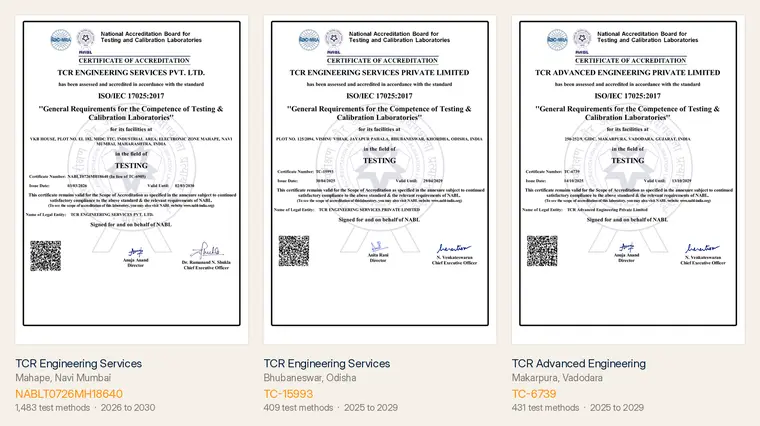
Three laboratories in the group hold their own ISO/IEC 17025:2017 accreditation, each assessed separately and each carrying its own certificate number and its own annexed scope.
| Laboratory | Entity | Certificate | Scope items | Valid |
|---|---|---|---|---|
| Mahape, Navi Mumbai | TCR Engineering Services Pvt. Ltd. | NABLT0726MH18640 | 1,483 | 3 Mar 2026 to 2 Mar 2030 |
| Bhubaneswar, Odisha | TCR Engineering Services Pvt. Ltd. | TC-15993 | 409 | 30 Apr 2025 to 29 Apr 2029 |
| Vadodara, Gujarat | TCR Advanced Engineering Private Limited | TC-6739 | 431 | 14 Oct 2025 to 13 Oct 2029 |


Alongside these, both TCR Engineering and TCR Advanced hold Nadcap AC7101 Materials Testing accreditation, under PRI certificates 29415245997 and 29227245998 respectively. All the certificates are on the downloads page, and the wider accreditation position is set out under quality, accreditations and approvals.
"A certificate is the last page of the work, not the first. What the assessors actually test is whether the quality manual, the technical procedures, the uncertainty budgets, the calibration records and the health and safety system describe the same laboratory that they are standing in. We keep those four aligned because that is how the system was designed to work, and the useful consequence is that when a Saudi Aramco or an ONGC audit team arrives with their own checklist, they are reading a system that already answers their questions. Approvals follow competence. They have never followed a brochure."
What changed at renewal
The renewal is not a like-for-like reissue. The certificate number itself changed, from TC-6905 to NABLT0726MH18640, under NABL's revised numbering. The scope was rebuilt rather than rolled forward: the civil and building materials block is materially deeper than the previous annexure carried, the restricted-substances group is present, and the site-testing section now runs to 100 methods, which is what makes accredited work at a client's plant possible rather than only at Mahape. Anyone holding an older reference to TC-6905 should update it to the current number.
Frequently asked questions
What is TCR Engineering's current NABL certificate number?
NABLT0726MH18640, issued 3 March 2026 and valid to 2 March 2030, for the Mahape laboratory in Navi Mumbai. It was issued in lieu of the previous number TC-6905 under NABL's revised numbering, so any specification or approved-vendor record still citing TC-6905 should be updated.
How many test methods are in the accredited scope?
1,483 in total: 1,383 permanent-laboratory methods and 100 site-testing methods, listed over a 131-page annexure. They span ten discipline groups covering mechanical properties of metals, chemical analysis, metallography, non-destructive testing, building materials, soil and rock, water, and restricted substances.
Does NABL accreditation mean my test report is accepted outside India?
Yes, where the test sits inside the accredited scope. NABL is a signatory to the ILAC Mutual Recognition Arrangement, under which accredited reports are accepted by purchasers and regulators in the other signatory economies without re-testing. TCR's ILAC MRA mark permission is NABL/ILAC/11591 and its CAB identifier is T-0294.
Do TCR Advanced and the Bhubaneswar laboratory have their own accreditation?
Yes. Each is assessed separately and holds its own certificate: TCR Advanced Engineering at Vadodara under TC-6739 with 431 scope items, and the TCR Engineering laboratory at Bhubaneswar under TC-15993 with 409 scope items. One entity's certificate never covers another entity's work.
How do I check whether a specific test is inside the accredited scope?
Read the annexure, not the certificate. Every accredited row names a discipline group, the material or product, the parameter tested and the test method. A test is accredited only when all four match your requirement. The full annexure is downloadable above, and TCR states any non-accredited capability as non-accredited on the quotation.