
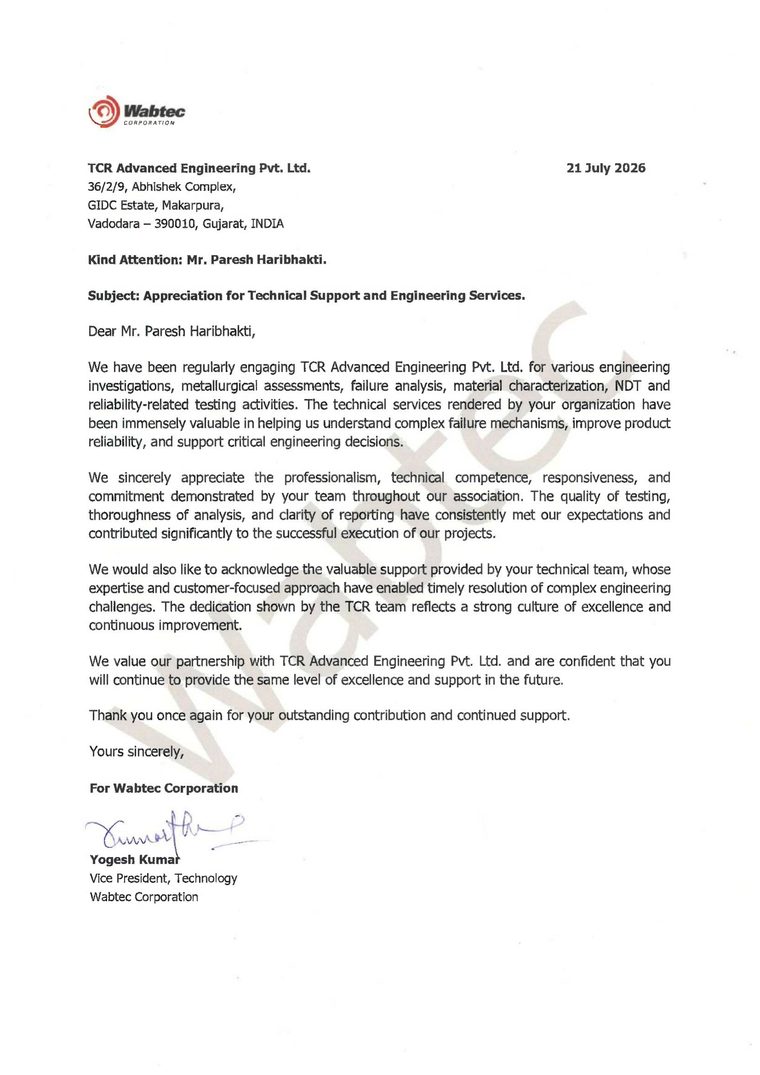
Wabtec Corporation has written to TCR Advanced Engineering Pvt. Ltd., Vadodara, to record its appreciation for the technical services TCR provides it. The letter is dated 21 July 2026 and is signed by Yogesh Kumar, Vice President, Technology. It names six areas of work and three qualities of the reporting behind them.
The letter names the following scope of engagement:
- Engineering investigations
- Metallurgical assessments
- Failure analysis
- Material characterisation
- Non-destructive testing
- Reliability-related testing
And it names what Wabtec values in the output: the quality of testing, the thoroughness of analysis, and the clarity of reporting.

Who wrote the letter, and about what
Wabtec Corporation is the global rail technology group listed on the New York Stock Exchange as WAB. It builds and supports locomotives, braking systems, rail components and digital systems for freight railroads and passenger transit authorities, with operations in more than 50 countries. For a manufacturer at that scale, a metallurgical opinion is not a document that goes into a file. It sits underneath a decision about whether a component design goes into production, whether a fleet needs an inspection campaign, and whether a supplier's material meets what the drawing says.
The letter is addressed to Paresh Haribhakti, Managing Director of TCR Advanced Engineering, and it describes a standing relationship rather than a single job. In Wabtec's own words, the company has been "regularly engaging" TCR Advanced across the six areas listed above, and the work has helped it understand complex failure mechanisms, improve product reliability, and support critical engineering decisions.
That last phrase is the one worth reading twice. A failure investigation earns its fee at the point where somebody signs a decision on the strength of it.
"An appreciation letter from an OEM of this size is really a statement about the report, not about the laboratory. Wabtec's engineers act on what we write. That is why we hold the discipline of stating the damage mechanism plainly, showing the evidence in the order that supports it, and saying where the uncertainty sits. A report that a client has to interpret has not finished the job."
The three things Wabtec named, and why they are the hard ones
Any accredited laboratory can produce a number. What separates a laboratory a client keeps calling from one it uses once is narrower than capability, and Wabtec's letter names it precisely.
Quality of testing. This is the part that accreditation covers, and it is the part most easily verified. TCR Advanced holds NABL accreditation to ISO/IEC 17025 under certificate TC-6739, with 431 accredited scope items, valid from 14 October 2025 to 13 October 2029. It is separately accredited by the Performance Review Institute to NADCAP AC7101 Materials Testing, certificate 29227245998, valid to 31 May 2027. Those two together mean the test method, the equipment calibration, the operator competence, the environmental conditions and the measurement uncertainty behind every reported figure are auditable by a third party, not asserted.
Thoroughness of analysis. A failure investigation goes wrong in a predictable way: the laboratory reports the fracture mode and stops. Fracture mode is an observation, not a cause. Getting to the cause means carrying the visual examination, the fractography, the metallography, the chemistry, the mechanical properties and the service history through to a single mechanism that every piece of evidence supports, and saying so when they do not all point the same way. Thoroughness is what stops an investigation ending at "fatigue" when the question was why the fatigue started.
Clarity of reporting. This is the one laboratories underrate. An engineering manager reading a failure report is deciding what to do on Monday. If the report buries the conclusion under twelve micrographs, or hedges the mechanism across three possibilities without ranking them, the reader has been handed the analyst's work rather than the analyst's judgement. Clarity means the conclusion is stated first, the evidence supports it in order, the uncertainty is quantified where it matters, and the recommendation is specific enough to act on.
Where the underlying capability sits
TCR Advanced Engineering is the Vadodara arm of the TCR group, employing more than 200 people, and its work runs to asset integrity, engineering consulting and contract research and development. Its metallurgical record base and its accredited mechanical, chemical and NDT benches are what a failure investigation draws on when the question is whether a fracture surface has been seen before.
For rail work specifically, the group's testing covers fatigue crack growth rate on rail track material to EN 13674 and rail fatigue to IRS:T-29, alongside the mechanical and metallurgical testing that component qualification requires. The wider group holds NABL accreditation at Navi Mumbai under TC-6905 and carries more than 9,000 documented failure investigations across 53 years.
What a client letter is and is not
An appreciation letter is not a technical finding, and it should not be read as one. It is evidence of a working relationship and of a client's judgement about how the work was done. Published here, it does one useful thing: it puts a named signatory, a date, and a specific scope behind a claim that laboratories usually make about themselves in the abstract.
The document is reproduced above in full and can be downloaded as received. Nothing has been extracted, summarised or paraphrased into it. Other client letters of the same kind are in the downloads library.
Frequently asked questions
What did Wabtec Corporation's letter to TCR Advanced Engineering say?
The letter, dated 21 July 2026 and signed by Yogesh Kumar, Vice President Technology, records Wabtec's appreciation for engineering investigations, metallurgical assessments, failure analysis, material characterisation, NDT and reliability-related testing. It names the quality of testing, the thoroughness of analysis and the clarity of reporting as what it values.
Is TCR Advanced Engineering accredited, and under which certificates?
Yes. TCR Advanced holds NABL accreditation to ISO/IEC 17025 under certificate TC-6739, covering 431 accredited scope items and valid from 14 October 2025 to 13 October 2029. It separately holds NADCAP AC7101 Materials Testing accreditation from the Performance Review Institute, certificate 29227245998, valid to 31 May 2027.
What is the difference between TCR Advanced Engineering and TCR Engineering?
TCR Engineering Services Pvt. Ltd. is the Navi Mumbai parent, founded 1973, accredited under NABL certificate TC-6905. TCR Advanced Engineering Pvt. Ltd. is the Vadodara company, accredited separately under TC-6739, employing more than 200 people and working in asset integrity, engineering consulting and contract research.
What does a failure analysis engagement with TCR cover?
A full investigation carries visual examination, fractography, metallography, chemical analysis, mechanical property testing and service history through to one damage mechanism that all the evidence supports. The report states the mechanism, the evidence order, the measurement uncertainty where it matters, and a specific corrective recommendation.
Which rail testing standards does the TCR group work to?
Rail work includes fatigue crack growth rate testing on rail track material to EN 13674 and rail fatigue testing to IRS:T-29, alongside the mechanical, chemical and metallurgical testing that component qualification requires. Group project experience includes the Mumbai to Ahmedabad High Speed Rail packages C1, C2 and C3.
Can I download the Wabtec appreciation letter?
Yes. The letter is published on this page in full as received, on Wabtec Corporation letterhead, and is available as a PDF download from the figure near the top of the article. Nothing in it has been extracted, summarised or paraphrased.